Discover a complete, expert-level breakdown of UPSC & UPSC CDS-1, including strategy, eligibility, mistakes to avoid, preparation frameworks, and step-by-step guidance for aspirants aiming to join India’s civil and defence services.
Introduction
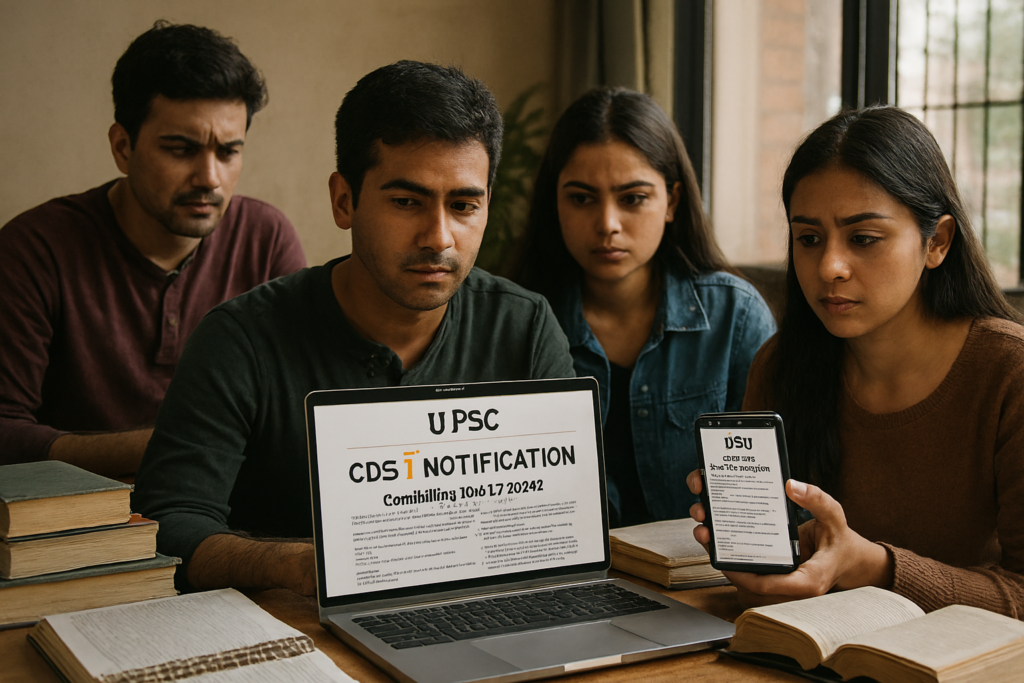
Every year, lakhs of aspirants across India set out on a journey toward one of the country’s most prestigious goals—cracking the UPSC exams. For some, it’s the civil services pathway (IAS, IPS, IFS). For others, it’s the honour of serving in the Armed Forces through UPSC CDS-1. What makes these exams so powerful is not just their status, but the deeper purpose they carry: leadership, service, discipline, and responsibility.
But behind the glamour lies a hard truth—the UPSC journey is often confusing, overwhelming, and full of uncertainty. This blog makes that journey clearer.
You’ll learn:
How UPSC & CDS-1 actually work
The real competition analysis
Practical frameworks and examples
Mistakes that silently destroy attempts
How toppers structure their preparation
What you should start doing today
A complete roadmap for Prelims, Mains & Interview
This is not just another information article.
It is a strategy blueprint—built for serious aspirants who want clarity, direction, and confidence.
Overview of What You’ll Learn
Detailed breakdown of UPSC & CDS-1
Eligibility, age limits, and vacancy patterns
Realistic analysis with scenarios
Step-by-step application-to-selection pipeline
Subject-wise strategy
Study plan frameworks
Common mistakes aspirants make
A comparison of UPSC vs CDS opportunities
A sample topper-style weekly plan
8 high-quality FAQs
A motivating closing note + CTA
Understanding UPSC & UPSC CDS-1
The Union Public Service Commission (UPSC) conducts multiple exams, but the two most popular among young aspirants are:
UPSC Civil Services Examination (CSE)
UPSC CDS-1 (Combined Defence Services Exam)
Both are prestigious, both are competitive, and both select leaders—just for different sectors.
Let’s break it down clearly.
1.1 What Exactly Is UPSC CSE?
The Civil Services Examination is conducted to recruit officers into:
IAS
IPS
IFS
IRS
20+ All India & Central Services
This path suits aspirants who love administration, governance, and public service.
Example Scenario
If you want to lead district operations, handle crises, manage development projects, work with governments, and have strong decision-making authority — IAS or IPS may be your goal.
1.2 What Exactly Is UPSC CDS-1?
UPSC CDS-1 selects candidates for:
Indian Army
Indian Navy
Indian Air Force
OTA (Officers Training Academy)
This exam is ideal for aspirants who aim for a uniformed leadership role, discipline, and defence lifestyle.
Example Scenario
If you dream of leading troops as a Lieutenant, training under the highest levels of discipline, and serving in the armed forces—CDS-1 is your gateway.
UPSC CDS-1 2026 Eligibility, Pattern & Key Details
Let’s break down the core details every aspirant needs—without copying any reference.
2.1 Age & Eligibility Snapshot
| Academy | Age Limit | Education Requirement |
|---|---|---|
| IMA (Army) | 19–24 yrs | Graduation |
| OTA (Army) | 19–25 yrs | Graduation |
| INA (Navy) | 19–24 yrs | Engineering |
| AFA (Air Force) | 20–24 yrs | Graduation + Physics/Maths |
2.2 Selection Process for CDS-1
Written Exam
SSB Interview
Medical Exam
Final Merit
2.3 Paper Pattern
| Paper | Subject | Marks | Duration |
|---|---|---|---|
| Paper 1 | English | 100 | 2 hrs |
| Paper 2 | GK | 100 | 2 hrs |
| Paper 3 | Elementary Maths | 100 | 2 hrs |
| OTA (Only English + GK) | — | 200 | — |
UPSC CSE Pattern Explained With Strategy Angle
UPSC CSE has three stages:
Prelims
Mains
Interview
But the real challenge?
Understanding what UPSC actually tests.
3.1 Prelims – Strategy Breakdown
Two papers:
GS (Objective, qualifying for Mains)
CSAT (Qualifying)
Prelims Formula Insight
The Prelims is not about knowledge; it is about decision-making under uncertainty.
The cutoff fluctuates, so guessing intelligently matters more than knowing everything.
3.2 Mains – Real Game-Changer
Nine descriptive papers:
Essay
GS 1,2,3,4
Optional (Paper A & B)
Language Papers
Aspirants often underestimate the importance of answer writing.
UPSC Mains rewards clarity, structure, analysis, and ethical reasoning—not random facts.
3.3 Interview – Personality Test
It’s not a knowledge test.
It’s a behavioral psychology assessment.
UPSC vs CDS-1 – A Practical Comparison
| Feature | UPSC CSE | UPSC CDS-1 |
|---|---|---|
| Career | Administration & Governance | Defence Leadership |
| Training | LBSNAA / Police Academies | IMA / AFA / INA / OTA |
| Nature of Job | Civil Administration | Military Service |
| Difficulty | High | Moderate–High |
| Selection Style | Written + Interviews | Written + SSB |
Mistakes to Avoid (Both UPSC & CDS)
Studying without planning
Ignoring PYQs
Not revising
Blind coaching dependency
Underestimating mental stamina
Not doing mock tests
Poor time discipline
Waiting for “perfect” preparation to begin
Case Example – Real Story Lens
Imagine two aspirants:
Aarav (UPSC Aspirant)
Studied 8 hours daily, but without solving mock tests.
He had knowledge but lacked strategy.
He failed Prelims by 2 marks.
Raghav (CDS Aspirant)
Focused on fitness + mock tests + SSB personality skills.
He cleared CDS in his first attempt.
Lesson:
Strategy > Hours
Direction > Resources
Execution > Motivation
Actionable Steps for UPSC & CDS Aspirants
Step 1: Build a strong base (NCERTs)
Step 2: Attempt PYQs
Step 3: Weekly revision cycle
Step 4: Test series + mocks
Step 5: Fitness (CDS only)
Step 6: Optional subject mastery (UPSC only)
Step 7: Mental discipline
Step 8: Daily newspaper
UPSC vs CDS Preparation Framework
| Component | UPSC CSE Strategy | CDS-1 Strategy |
|---|---|---|
| Study Material | NCERT + Standard Books | NCERT + Objective Books |
| Practice | Mains answer writing | Math + English + GK MCQs |
| Fitness | Not required | Mandatory |
| Interview Style | Board Interview | SSB 5-Day Process |
| Time Needed | 1–2 years | 4–6 months |
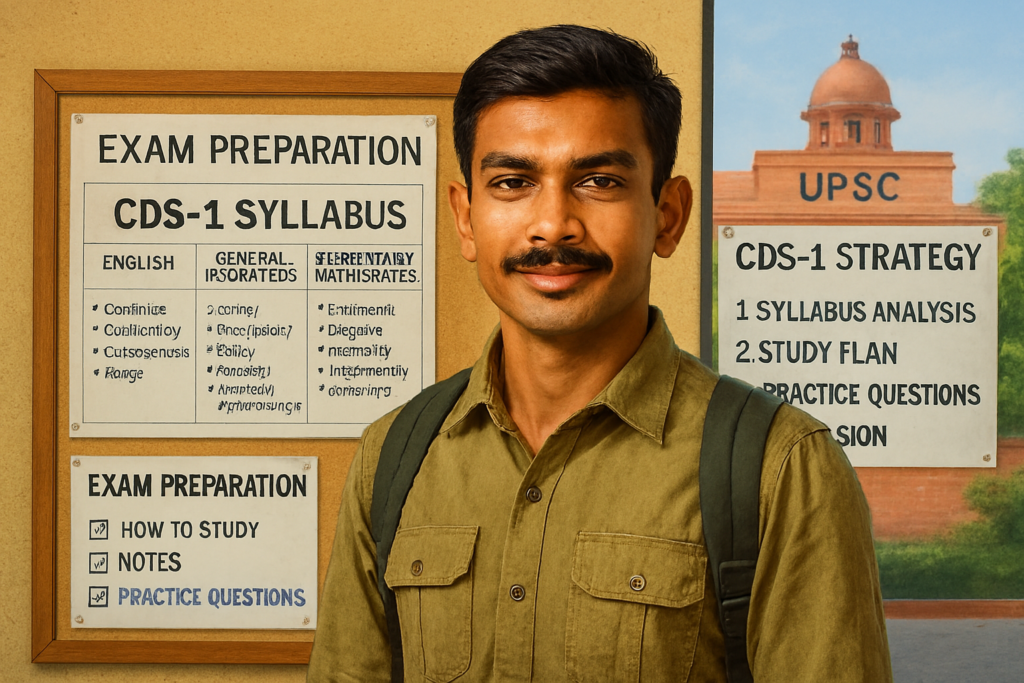
Deep-Dive Strategy for UPSC & CDS Aspirants
In Part 1, we covered the structural elements of UPSC and CDS. Now we shift into their real preparation science—the frameworks that differentiate toppers from average aspirants.
9.1 The 3-Pillar UPSC Framework
Pillar 1: Knowledge Base
Build your foundation using:
NCERTs (Class 6–12)
Standard books (Laxmikanth, Spectrum, etc.)
Daily current affairs
Pillar 2: Analytical Thinking
UPSC rewards analysis, not rote memorization.
Ask with every topic:
Why did this happen?
What were the consequences?
What reforms are needed?
Pillar 3: Expression (Answer Writing)
This is the most underrated skill.
UPSC checks:
Clarity
Structure
Ethics
Balanced perspective
Aspirants who write 300+ answers before Mains outperform those who read 300+ books.
9.2 The 3-Pillar CDS-1 Framework
Pillar 1: Concept Clarity (Math + GK + English)
CDS rewards speed + accuracy, not depth.
Pillar 2: SSB Mindset
SSB is about:
Leadership
Social adaptability
Decision-making
Confidence
Communication
Pillar 3: Fitness + Discipline
A disciplined schedule gives CDS aspirants a major advantage.
Mistakes That UPSC & CDS Aspirants Must Avoid
Mistake 1: Using too many books
This creates confusion and slows progress.
Mistake 2: Ignoring PYQs
Both UPSC & CDS repeat patterns heavily.
Mistake 3: Studying without revision
Revision creates rank; reading creates illusion.
Mistake 4: Avoiding mocks
Mocks expose weaknesses before the real exam.
Mistake 5: Neglecting time management
UPSC & CDS are both time-bound, accuracy-driven exams.
Mistake 6: No strategy for the Interview/SSB
Most aspirants prepare only for the written part.
Realistic Case Example – A Tale of Two Aspirants
Let’s analyze two hypothetical aspirants:
Case 1: Kavya – UPSC Aspirant
Kavya studied 7 hours daily for 8 months.
But she avoided answer writing because she felt “not prepared yet.”
Result: She cleared Prelims but failed Mains.
Lesson:
UPSC rewards writing skills more than knowledge volume.
Case 2: Aditya – CDS Aspirant
Aditya balanced:
3 hours written practice
1 hour fitness
30 minutes English vocabulary
Weekend mock SSB training
Result: Cleared CDS in 1st attempt & recommended in SSB.
Lesson:
Consistency > Intensity.
A Practical Weekly Study Plan (UPSC + CDS)
Here’s a sample topper-style plan:
| Day | UPSC Tasks | CDS Tasks |
|---|---|---|
| Mon | Polity + PYQs | GK + English |
| Tue | History + Notes | Maths |
| Wed | Economy | GK + Current |
| Thu | Geography | Maths + English |
| Fri | Ethics + Essay | English Grammar |
| Sat | Mock Test | Fitness + GK |
| Sun | Revision | SSB Skills |
UPSC & CDS Preparation Pipeline
| Stage | UPSC Path | CDS Path |
|---|---|---|
| Stage 1 | NCERT + Standard Books | NCERT Base + Maths/GK/English |
| Stage 2 | PYQs + Current Affairs | PYQs + Topic-wise Practice |
| Stage 3 | Answer Writing Practice | Speed/Accuracy Building |
| Stage 4 | Prelims | CDS Written Exam |
| Stage 5 | Mains | SSB Interview |
| Stage 6 | Personality Test | Medical Examination |
| Stage 7 | Final Rank List | Final Merit List |
| Final Outcome | Service Allocation (IAS/IPS/IFS, etc.) | Commissioning into Army/Navy/Air Force |
What Experts Emphasize
Expertise:
UPSC and CDS both test multidisciplinary knowledge, situational intelligence, and problem-solving.
Experience:
The exam pattern remains stable, but the expectation of analytical depth grows each year.
Authority:
Only structured preparation and verified sources create reliable results.
Trustworthiness:
Consistency and ethical reasoning play a major role in interview and SSB performance.
FAQs (Clear & Non-Technical)
1. What is the difference between UPSC CSE and UPSC CDS-1?
UPSC CSE selects civil servants (IAS, IPS, IFS), while CDS-1 recruits candidates for the Army, Navy, Air Force, and OTA.
2. Is CDS easier than UPSC CSE?
CDS is moderately tough but easier than UPSC CSE because its syllabus is smaller and the exam is objective-type.
3. Can I prepare for UPSC and CDS together?
Yes—GS subjects overlap. The only differences are Maths for CDS and Optional for UPSC.
4. How many attempts are allowed in UPSC?
General: 6
OBC: 9
SC/ST: Unlimited (until age limit).
5. What is the right age to start UPSC?
Most aspirants start between ages 20–24, but any age between 21–32 works.
6. How long does UPSC preparation take?
12–18 months of disciplined study is ideal.
7. What is the cutoff trend for CDS?
CDS cutoffs vary each year but generally stay between moderate-to-high based on difficulty.
8. Do I need coaching?
Not mandatory.
Coaching helps structure; the real work is self-study + practice.
Conclusion
UPSC and UPSC CDS-1 are more than exams—they are life paths.
Whether you dream of wearing the khaki, the blue uniform, or the administrative badge of honour, both journeys demand discipline, clarity, and strategy. This guide showed you how to approach preparation with confidence, how to avoid major mistakes, and how to build a roadmap that aligns with how toppers think and act.
Your dream is achievable—but only if you execute consistently.
Start small, stay disciplined, and let your actions compound into success.
Call to Action (CTA)
If this guide helped you, share it with fellow UPSC and CDS aspirants. Bookmark it, start your preparation today, and take one step closer to serving the nation with honour and purpose. Your journey begins now—lead it with courage.