The SSC JE Answer Key 2025 is more than a response sheet—it’s a performance mirror for engineering aspirants. This guide explains how to analyse your answers, predict outcomes, and plan smartly for what comes next.
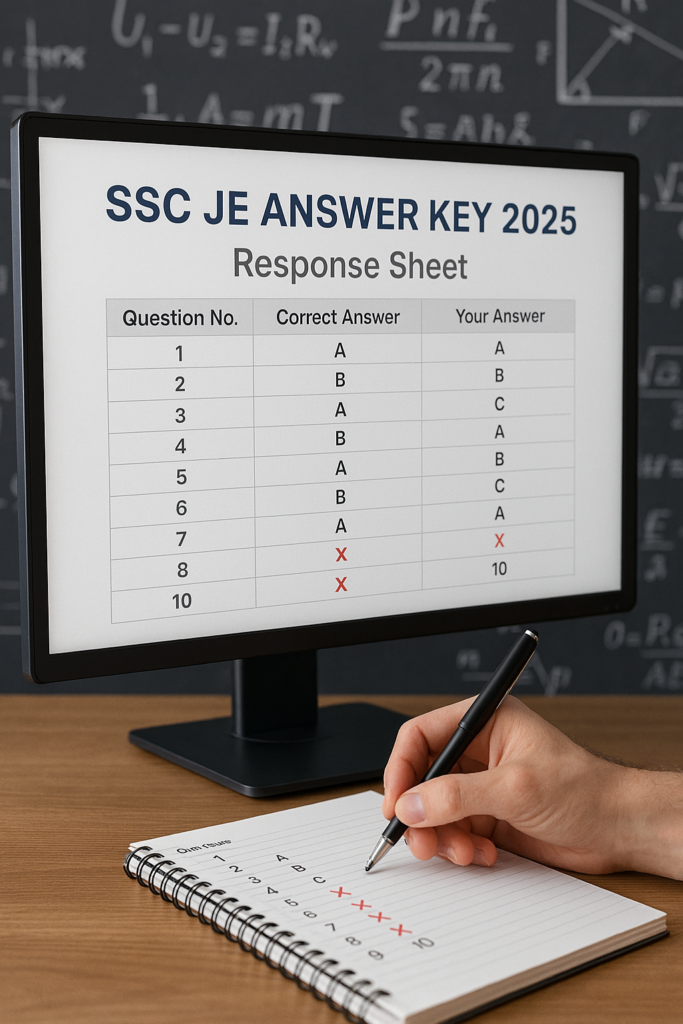
Table of Contents
Introduction
When the SSC JE answer key is released, most candidates rush to calculate marks. But experienced aspirants know something deeper: the answer key is not just about numbers—it’s about direction.
The SSC JE Answer Key 2025 helps you understand:
Whether your preparation approach worked
How close you are to the cut-off zone
If raising objections is worth the effort
What your realistic next step should be
This article doesn’t repeat official instructions. Instead, it helps you think like a serious SSC JE aspirant, not just a result-checker.
What the SSC JE Answer Key 2025 Actually Represents
At a surface level, the answer key is a list of correct answers. But at a strategic level, it is a diagnostic tool.
What You Can Decode From the Answer Key
Accuracy vs attempts ratio
Conceptual clarity in core engineering topics
Risk-taking behaviour in the exam
Time management effectiveness
In competitive exams like SSC JE, how you attempted matters as much as how much you attempted.
Understanding the Importance of the Answer Key Stage
Many candidates underestimate this stage and mentally “wait for results.” That’s a mistake.
Why the Answer Key Phase Is Critical
It is the only stage where corrections are possible
It allows early prediction of qualification chances
It helps plan the next phase without panic
It reveals recurring conceptual mistakes
Ignoring this phase means losing control over the process.
Score Calculation: Do It Right or Don’t Do It at All
Blindly adding marks without understanding marking logic creates false hope or unnecessary fear.
Correct Way to Calculate SSC JE Score
Add marks for correct answers
Deduct negative marks for incorrect responses
Ignore unanswered questions
Use official marking scheme only
But here’s the catch:
Raw score alone does not decide selection.
Normalisation Factor: The Silent Influencer
SSC JE exams often happen in multiple shifts. This brings normalisation into play.
What Normalisation Changes
Two candidates with same raw marks can end up with different final scores
Slightly lower raw scores in tougher shifts may scale higher
Borderline candidates must consider shift difficulty seriously
This is why comparing marks blindly with friends is misleading.
Example Scenario: Same Score, Different Outcome
Candidate A
Raw Score: 122
Shift: Moderate
Candidate B
Raw Score: 118
Shift: Tough
After normalisation, Candidate B may outrank Candidate A.
Lesson: Never declare success or failure solely on raw marks.
Should You Raise an Objection? Think Strategically
Raising objections is a right—but not always a smart move.
When Objections Make Sense
Clear conceptual mismatch
Standard textbook contradiction
Technical error affecting many candidates
When Objections Are a Waste
Guess-based confidence
Coaching-based disagreement without proof
Emotional reaction after low score
Objections require logic, not hope.
Common Mistakes Candidates Make With Answer Keys
Calculating marks using unofficial keys
Raising objections without evidence
Ignoring normalisation impact
Assuming cut-offs based on rumours
Stopping preparation immediately
These mistakes cost candidates months of opportunity.
Table: Smart vs Risky Behaviour After Answer Key
| Action | Outcome |
|---|---|
| Objective score analysis | Clarity |
| Evidence-based objections | Possible gain |
| Emotional comparison | Confusion |
| Early next-stage prep | Advantage |
SSC JE Answer Key 2025: What It Tells About Competition
One noticeable trend in 2025:
Higher attempt accuracy among serious aspirants
Less random guessing
Better technical depth in core subjects
This means cut-offs depend more on precision than volume.
How SSC Views This Stage
From SSC’s perspective, the answer key stage:
Ensures transparency
Filters genuine grievances
Protects exam integrity
Candidates who approach this phase maturely often perform better in later stages.
SSC JE Answer Key 2025 Cut-Off Logic: What Numbers Really Mean
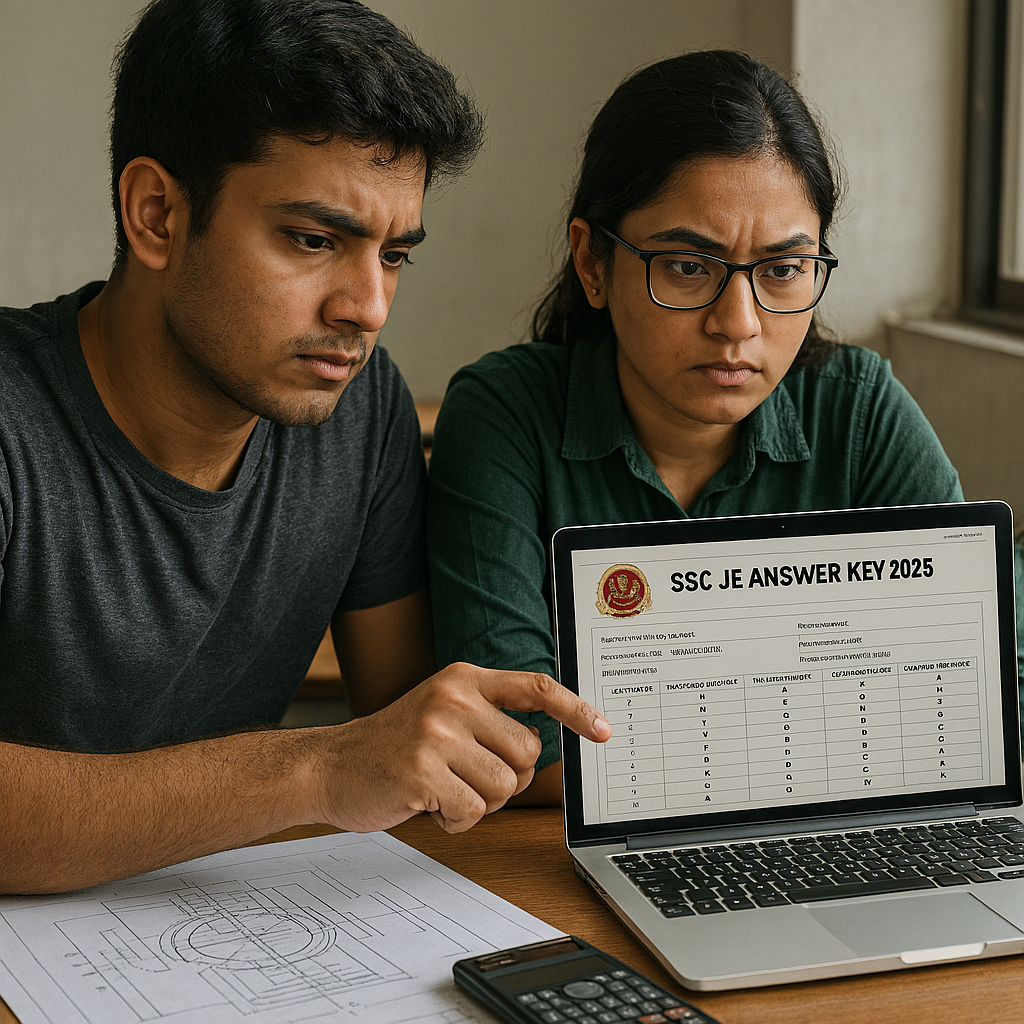
After analysing your score using the SSC JE answer key, the next question is inevitable:
“Is this enough?”
The truth is, SSC JE cut-offs are not fixed numbers. They are outcomes of competition dynamics.
Factors That Shape SSC JE Cut-Offs
Number of candidates appearing
Difficulty level of the paper
Engineering stream-wise vacancies
Shift-wise normalisation impact
Overall performance trend
This is why SSC never declares cut-offs before final evaluation.
Expected Cut-Off Trend: Analytical View (Not Guesswork)
Instead of guessing numbers, smart aspirants look at zones.
Safe, Borderline & Risk Zones Explained
| Score Zone | What It Indicates |
|---|---|
| High Margin Above Avg | Strong qualification chance |
| Near Expected Range | Borderline – depends on normalisation |
| Below Average | Needs backup strategy |
Key Insight:
Borderline candidates often succeed if their shift difficulty is higher.
Case Comparison: SSC JE 2023 vs 2025 Pattern
2023 Trend
High attempts, lower accuracy
Wider score variation
2025 Trend
Fewer attempts, higher precision
Tighter competition cluster
This indicates that even 1–2 marks can change outcomes in 2025.
What To Do Based on Your Answer Key Score
If Your Score Is Clearly Above the Expected Range
Start preparing for the next stage immediately
Revise weak core subjects
Do not relax completely
If You Are Borderline
Continue preparation without panic
Track official updates closely
Prepare as if you are selected
If You Are Below the Range
Analyse where mistakes happened
Decide whether to:
Attempt next SSC cycle, or
Switch to parallel engineering exams
Failure is only permanent if learning stops.
Mistakes Aspirants Make After Answer Key (That You Must Avoid)
Waiting idle until final results
Comparing marks obsessively
Quitting preparation early
Ignoring technical fundamentals
Trusting unofficial cut-off claims
Competitive exams reward consistency, not reaction.
Strategic Comparison: SSC JE vs Other Engineering Exams
| Aspect | SSC JE | Other Engg Exams |
|---|---|---|
| Transparency | Very High | Varies |
| Competition | Extremely Tight | Moderate |
| Career Stability | Strong | Depends |
| Cut-Off Volatility | High | Medium |
SSC JE remains one of the most reliable engineering careers, but demands patience.
How Toppers Use Answer Keys Differently
Experienced candidates don’t celebrate or panic after answer keys.
They use them to:
Identify weak concepts
Improve question-selection strategy
Refine time management
Prepare mentally for uncertainty
That mindset—not marks alone—creates repeat success.
Frequently Asked Questions (FAQs)
1. Is the SSC JE answer key final?
No. It is provisional and open for objections before finalisation.
2. Can my score change after objections?
Yes, if objections are accepted officially.
3. Is normalisation applied before result?
Yes, final scores consider normalisation.
4. Should I stop studying after checking answer key?
No. This is the most common mistake.
5. Are unofficial cut-offs reliable?
No. They are estimates, not decisions.
6. Does one wrong answer matter in SSC JE?
Yes. Even a single mark can impact rank.
7. Is objection fee refundable?
Only if the objection is accepted.
8. What if I miss the objection window?
Then the provisional key becomes final for you.
Conclusion: What the SSC JE Answer Key 2025 Truly Teaches
The SSC JE answer key 2025 is not about fear or celebration.
It is about clarity.
It teaches you:
How competitive you really are
Where your preparation stands
What strategy needs improvement
How close you are to your goal
Every serious engineer learns from this phase—selected or not.
Call to Action (CTA)
Don’t wait for results to decide your future.
Use the SSC JE answer key as feedback, not a verdict.
Analyse smartly, prepare consistently, and stay exam-ready.