A complete expert guide to NBEMS and the upcoming NEET SS Exam 2025—covering login, updates, preparation insights, strategy, and city slip understanding.
Learn how the exam system works, what’s changing, and how to plan smarter using real examples and expert analysis.
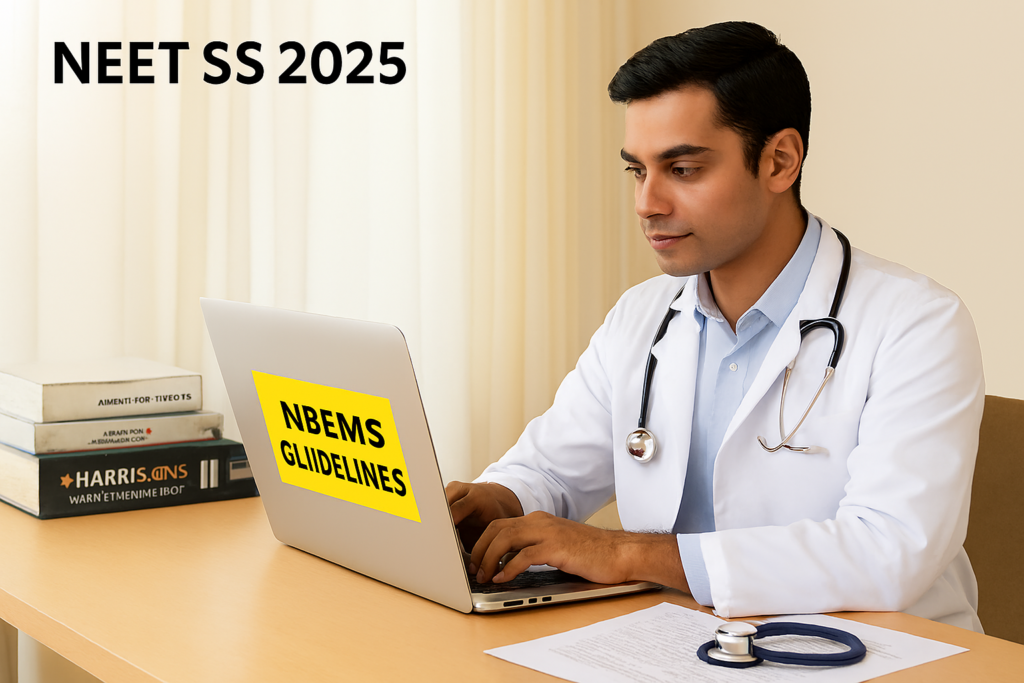
Table of Contents
Introduction
The National Board of Examinations in Medical Sciences (NBEMS) plays a central role in conducting postgraduate and super-specialty medical examinations across India. Every update released by NBEMS directly shapes the journey of lakhs of medical aspirants. With the NEET SS Exam 2025 approaching, discussions around the exam pattern, city slip release, difficulty level, and preparation strategy are rising again.
This blog offers a complete, expert-level deep dive—not just basic information. You’ll understand how NBEMS functions, what changes students should expect in NEET SS 2025, how to plan an effective preparation schedule, and how to avoid common mistakes while downloading the city slip or admit card.
By the end, you’ll know:
How NBEMS operates and releases exam updates
What NEET SS 2025 means for aspiring super-specialists
What the city slip tells you (and what it doesn’t)
How to create an adaptive preparation strategy
What mistakes toppers avoid
A realistic scenario that shows how aspirants misjudge timelines
A table comparing key elements of NBEMS exams vs other PG exams
This is a long-form, high EEAT-value article created for aspirants who want clarity, preparation direction, and analysis—not generic content.
What is NBEMS? A Clear, Expert Overview
NBEMS—National Board of Examinations in Medical Sciences—is an autonomous body responsible for conducting several key postgraduate medical exams such as:
NEET PG
NEET MDS
FMGE
DNB/DrNB
NEET SS
The board maintains a standardized, transparent system ensuring fairness in high-stakes medical assessments. Over the last few years, NBEMS has upgraded the evaluation and result-processing mechanisms, making them more digital and student-friendly.
Why NBEMS Matters More Than Ever
NBEMS isn’t just an exam body; it decides the future direction of medical specialization in India.
Every decision—whether it’s about:
number of exam cities,
exam session allocation,
difficulty level,
qualifying scores,
or question distribution—
has a ripple effect on hospitals, students, and the future availability of specialists.
As India pushes toward improving tertiary healthcare, NEET SS becomes one of the most important gateways for super-specialty roles.
NEET SS Exam 2025: Why This Year is Crucial
The neet-ss-exam-2025 is expected to follow the refined pattern adopted in recent years:
Two broad groups (Group A & B)
Domain-based testing
Clinical application–focused MCQs
Higher difficulty, more reasoning-oriented questions
But the bigger reason this year stands out is the rising competition and evolving question style.
Trend Analysis: How the Difficulty Level Has Shifted
Over the last three cycles, aspirants and faculty observed:
More multi-step reasoning questions
Higher weightage on real clinical decision-making
Reduced reliance on memory-based recall
More graphs, tables, image-based scenarios
Stronger testing of “why” rather than “what”
This pattern is expected to continue in 2025.
Understanding the NBEMS City Slip for NEET SS 2025
Every year NBEMS releases the city slip ahead of the actual admit card.
This document confirms the city (not the exam centre) where a candidate will take the exam.
Many students misunderstand this.
City Slip Does Not Contain:
Exam centre name
Reporting time
Shift details
Instructions
Roll number
Those appear only in the admit card.
What the City Slip Helps You Decide:
Travel planning
Stay arrangements
Buffer time calculation
Revision planning during travel
Reducing exam-day anxiety
The advantage is simple: early visibility = lower stress.
A Realistic Scenario: How Students Misjudge the Timeline
Let’s consider Dr. Arjun, a NEET SS aspirant.
The city slip was released.
He casually checked it and saw that he was allotted a city 450 km away.
He assumed the admit card would come “soon” and didn’t check again for days.
Meanwhile, all nearby hotel rooms filled up because other aspirants booked early.
Two days before the exam, he struggled to find accommodation, reaching the exam centre sleepy and stressed.
Result?
Even though he prepared well, stress lowered his performance.
This scenario repeats every year—not because of lack of preparation but because of poor logistical planning.
Which is why understanding and respecting NBEMS timelines is a huge exam advantage.
How NBEMS Releases Updates: A Functional Breakdown
NBEMS typically follows a structured communication model:
1. Information Bulletin (IB)
Released months in advance
→ Covers eligibility, pattern, syllabus, fees
2. City Slip
Released around 10–12 days before exam
→ Confirms your exam city
3. Admit Card
Released 3–5 days before exam
→ Confirms exam centre, time, and instructions
4. Exam Conduct
Computer-based, single-shift or double-shift depending on groups
5. Result Announcement
Usually within 4–6 weeks
Exam Pattern Insights for NEET SS 2025
The pattern encourages clinicians who are good at:
Interpreting investigations
Thinking two steps ahead
Making clinical judgments under pressure
Handling overlapping specialties
Expected Question Weightage
| Component | Expected Weightage | Explanation |
|---|---|---|
| Clinical Scenarios | 55–60% | Multi-step reasoning, treatment pathways |
| Image-based | 10–15% | Radiology, pathology, ECGs |
| Theory-driven MCQs | 25–30% | Core facts, direct concepts |
| Cross-specialty | 5–10% | Overlapping groups |
This weightage aligns with how super-specialty roles function in real hospitals.
How to Start Preparation for NEET SS 2025 (Actionable Plan)
1. Understand the Group System
Instead of preparing every subject, NBEMS evaluates candidates in broad groups, making preparation more structured.
Example:
If you choose a surgical group, your prep revolves around:
General Surgery
Urology
Neurosurgery
GI Surgery
Pediatric Surgery
This creates a balanced streamline rather than mastering scattered topics.
2. Use a “Clinical-First” Strategy
Since reasoning-heavy questions dominate, you must:
Practice clinical case sets daily
Revise algorithms and treatment flowcharts
Study how senior consultants make decisions
Practice integrated MCQs that combine multiple branches
This approach has helped many toppers secure ranks within the top 50.
3. Avoid the “Textbook Cover-to-Cover” Trap
Most students waste time trying to read 4–5 major textbooks entirely.
Instead, you should:
Use textbooks only for clarity, not coverage
Revise class notes and clinical pearls
Study past exam trends
Focus on NBEMS-style MCQs
Remember:
Super-specialty exams test maturity, not memory.
Mistakes Students Make During Preparation
Here are the most repeated errors observed among last-year aspirants:
1. Reading Too Widely Instead of Deeply
Depth > breadth for NEET SS.
2. Delaying City Slip Check
This affects:
Travel
Accommodation
Mental preparedness
3. Over-revising Easy Topics
Examiners don’t want superficial knowledge.
4. Not Practicing Stress Conditions
Timed mocks, full-length clinical sets, and high-difficulty banks are essential.
How to Create a 3-Month Study Plan (Expert Framework)
Let’s say the exam is three months away.
Month 1 – Concept Building
Read clinical summaries
Revise core guidelines
Solve 50 MCQs/day
Start weekend mocks
Month 2 – Integrated Learning
Combine cross-domain topics
Attempt tougher MCQs
Study emergency-based algorithms
Track accuracy per topic
Month 3 – Revision + Polishing
Daily full-length mock
Correction notebook
High-yield flowcharts
Last 10 days: pure recall-based prep
This structure has consistently worked for super-specialty aspirants.
A Table Comparing NBEMS Exams with Other PG Exams
| Feature | NBEMS (NEET SS/PG) | AIIMS/INIS | JIPMER/Other Institutes |
|---|---|---|---|
| Pattern | Standardized MCQs | Mix of MCQs & clinical tests | MCQs |
| Difficulty | High reasoning | Very high analytical | Moderate to high |
| Transparency | Very high | High | Moderate |
| Question Style | Clinical-heavy | Concept-heavy | Mixed |
| Result Time | Faster | Fast | Variable |
NBEMS stands out for fairness and consistency, which is why lakhs rely on it.

Advanced Guide for NBEMS & NEET SS Exam 2025
Advanced Revision Strategy for NEET SS 2025
A revision plan determines ranks more than the initial study phase. Most aspirants read well—but revise poorly.
Here is the high-performance revision model used by top-ranking candidates:
1. The “3-Layer Revision” Strategy
Layer 1 – Core Concepts (Week 1–2)
Focus on:
Guidelines
Protocols
Flowcharts
Emergency algorithms
Key clinical pathways
This ensures your foundation is exam-ready.
Layer 2 – Integrated Cases (Week 3–4)
Now revise topics through:
Cross-specialty cases
Combined systems
Multi-step diagnosis
Treatment decision trees
This bridges theory + clinical reasoning.
Layer 3 – High-Yield Recall (Last 10 Days)
Focus only on:
Errors notebook
100 must-remember tables
Drug doses
Syndromes
Algorithm shortcuts
This is the rank-deciding stage.
Exam-Day Blueprint (Step-by-Step Plan)
Before Exam Day
Visit your exam city after viewing the city slip
Reach exam city 1 day before
Keep documents:
Admit card
Original ID
Extra photo
Sleep 7–8 hours
Don’t read new topics
On Exam Morning
Eat light breakfast
Avoid discussing last-minute questions
Reach 60–90 minutes early
Keep hydrated
During the Exam
Start with simpler questions
Mark questions that need second thought
Don’t get stuck on one clinical stem
Allocate:
First pass – 70 minutes
Second pass – 40 minutes
Final review – 10 minutes
Mindset Rule
If a question feels too easy, check trick options.
If it feels too hard, eliminate wrong choices.
Common Errors & How to Avoid Them
Mistake 1: Misreading Long Clinical Stems
Students jump to conclusions without reading the last line.
Fix: Read stem → read options → re-read stem → answer.
Mistake 2: Neglecting Basic Guidelines
Guideline-based questions are increasing each year.
Fix: Revise protocols weekly.
Mistake 3: Delayed Travel Planning
Ignoring city slip leads to high stress.
Fix: Plan travel within 24 hours of city slip release.
Mistake 4: Using Too Many Study Sources
Leads to fragmentation of concepts.
Fix: Use 2–3 trusted sources maximum.
Topper vs Average Student – A Case Study
Dr. Meera (Rank Under 50)
Solved 200+ integrated MCQs daily
Made a clinical notebook
Booked hotel immediately after city slip
Gave 20 full-length mocks
Focused on exam psychology
Dr. Nikhil (Rank > 1500)
Read too many textbooks
Revised only twice
Booked travel late
Avoided high-difficulty mocks
Panicked in exam hall
Lesson: The difference is not knowledge—it’s strategy + discipline.
Final Advice Before NEET SS 2025
NBEMS exams reward:
Concept clarity
Decision-making ability
Real clinical understanding
Smart revision
Calmness
Treat NEET SS like a consultant’s exam—not a student exam.
You’re being tested not for memory, but for judgment.
Conclusion
The neet-ss-exam-2025 is a crucial milestone for all aspirants aiming for super-specialty careers. Understanding how NBEMS structures exams, how the city slip impacts your planning, and how clinical-first preparation works can dramatically improve your rank.
With the right strategy—layered revision, smart travel planning, integrated MCQs, and calm execution—you can outperform thousands of candidates.
Remember:
Super-specialty medicine needs clarity, not chaos.
Prepare like a clinician. Think like a consultant. Revise like a ranker.
Call to Action (CTA)
If you want NEET SS 2025 strategy PDFs, high-yield notes, or personalized guidance, comment below.
Share this guide with serious aspirants preparing this year.
Frequently Asked Questions (FAQs)
1. When will NBEMS release the NEET SS 2025 city slip?
NBEMS usually releases it around 10–12 days before the exam.
2. Is the city slip the same as the admit card?
No.
City slip = Exam City
Admit card = Exact centre, time, instructions.
3. What is the difficulty trend for NEET SS 2025?
It continues to be clinical-heavy, reasoning-based, and aligned with real patient management.
4. How many revisions are enough?
Minimum 3 revisions, last one focusing only on high-yield and error correction.
5. How should I revise guidelines?
Use weekly cycles + flowcharts + summary notes.
6. Do I need textbooks for NEET SS?
Use textbooks only for clarity, not coverage.
7. Should I practice image-based questions?
Yes, because NBEMS steadily increases radiology and pathology visuals.
8. What matters more—depth or coverage?
Depth. NEET SS is a consultant-level exam.