MPPSC has officially opened Assistant Professor Recruitment 2026, creating a major opportunity for aspirants aiming for a stable academic career.
This guide explains eligibility, application strategy, mistakes to avoid, and how to maximize your selection chances.
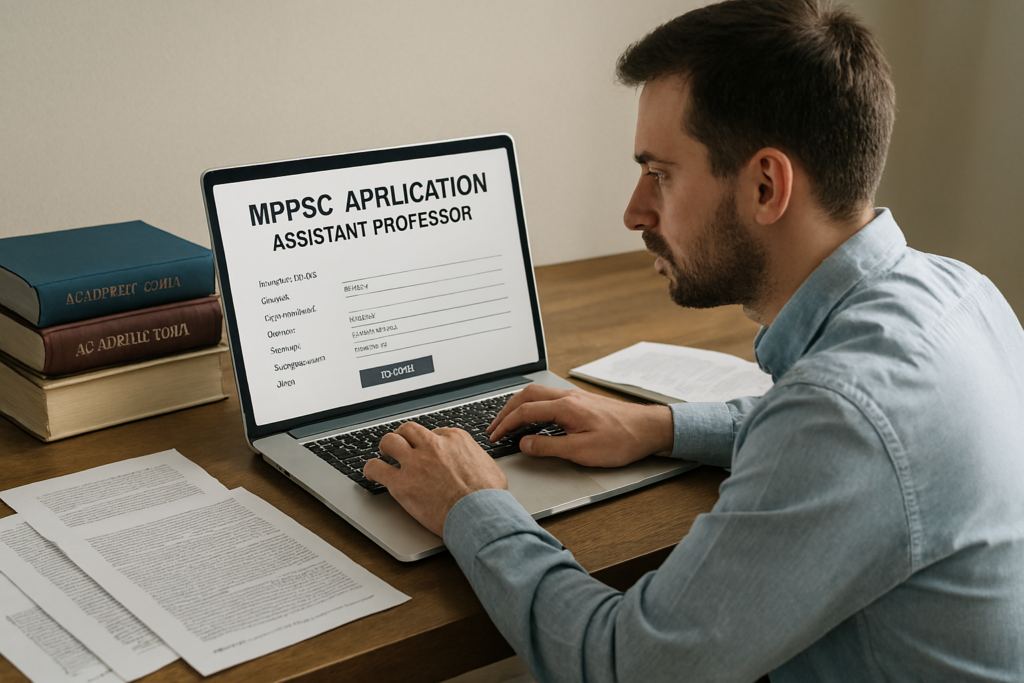
Table of Contents
Introduction: Why MPPSC Assistant Professor 2026 Matters
When Madhya Pradesh Public Service Commission (MPPSC) announces a large-scale recruitment like the Assistant Professor Recruitment 2026, it immediately shifts the focus of thousands of postgraduate and PhD holders across the state and beyond.
This is not just another government notification. For many aspirants, this recruitment represents:
Entry into permanent government teaching service
Long-term academic stability
A platform to contribute to higher education in Madhya Pradesh
In this article, you’ll learn:
What MPPSC Assistant Professor Recruitment 2026 really means for your career
Who should apply and who should pause
How to apply strategically, not mechanically
Common mistakes that cost candidates years
A real-life style case comparison
What to do after applying, not just before
This is written from an exam-mentor and academic-career perspective, not a news rewrite.
Understanding MPPSC Assistant Professor Recruitment 2026 Beyond the Notification
Most blogs stop at “X posts released, apply here.”
That’s surface-level information.
Let’s go deeper.
What Makes This Recruitment Significant?
MPPSC Assistant Professor recruitment is different from:
Guest faculty hiring
Contract-based college appointments
University-level ad hoc posts
This recruitment leads to regular cadre positions in government colleges, governed by:
UGC norms
State service rules
Structured promotions and academic growth
In simple terms: this is a career-defining exam, not a temporary job test.
Who Should Seriously Consider Applying (And Who Shouldn’t)
Ideal Candidates
You should strongly consider applying if:
You have postgraduation with required subject specialization
You are preparing or have cleared NET / SET / PhD (as per norms)
You want long-term academic security, not short-term contracts
Candidates Who Need to Pause and Recheck
You should pause and re-evaluate if:
Your PG subject does not exactly match the advertised discipline
You are relying on “later document correction” (risky mindset)
You are applying blindly without understanding syllabus depth
Expert Insight :
Most rejections happen not due to exams, but due to eligibility mismatch discovered during verification.
MPPSC Assistant Professor 2026: Strategic View of Vacancies
Instead of just seeing “number of posts,” look at:
Subject-wise distribution
Long-gap departments (where recruitment was delayed earlier)
Competition density per subject
Why This Matters
Subjects with:
Fewer colleges
Limited PG output
Specialized disciplines
Often have lower competition per seat, even if total posts are less.
This is where informed candidates gain an edge.
Application Process: Actionable Step-by-Step Strategy (Not Just Steps)
Step 1: Document Readiness (Before Login)
Before opening the application portal:
Match your degree title word-by-word
Keep scanned documents in correct format
Recheck category certificates validity
Strategy Tip:
Candidates who rush to apply on Day 1 often make avoidable clerical mistakes.
Step 2: Online Application Filling (Critical Phase)
While filling the application:
Subject selection must match UGC-recognized discipline
Personal details must match academic certificates exactly
Do not assume correction window will fix major errors
Expert Observation:
Correction windows usually allow limited fields, not core eligibility data.
Step 3: Fee Payment & Final Submission
Save payment confirmation
Download final submitted form
Cross-check subject code and category once again
Common Mistakes Candidates Make (Read This Carefully)
This section alone can save you one full recruitment cycle.
Mistake 1: Treating It Like Any Other Form
Many aspirants apply casually because:
“It’s just an application; we’ll see later.”
Reality:
Application errors = permanent disqualification, even after clearing written exams.
Mistake 2: Subject Name Assumption
Example:
PG in “Public Administration”
Applying for “Political Science”
Even if syllabus overlaps, MPPSC follows strict nomenclature rules.
Mistake 3: Ignoring Age & Reservation Proofs
Outdated certificates
Incorrect formats
Missing authority seals
These issues surface during document verification — too late to fix.
Case Example: Two Aspirants, Two Outcomes
Candidate A
Applied early
Didn’t cross-check subject equivalence
Cleared written exam
Rejected at verification stage
Candidate B
Took 2 extra days
Verified subject eligibility
Corrected minor form details
Qualified smoothly
Difference was not intelligence, but application discipline.
One Table for Better Understanding
| Factor | Casual Applicant | Strategic Applicant |
|---|---|---|
| Form Filling | Rushed | Verified |
| Subject Match | Assumed | Confirmed |
| Document Prep | After exam | Before application |
| Result | Risky | Stable |
Why Trust This Analysis
This analysis reflects:
Patterns observed in MPPSC & state PSC recruitments
Academic recruitment verification norms
Real applicant experiences from past cycles
It is not copied content — it is process intelligence.
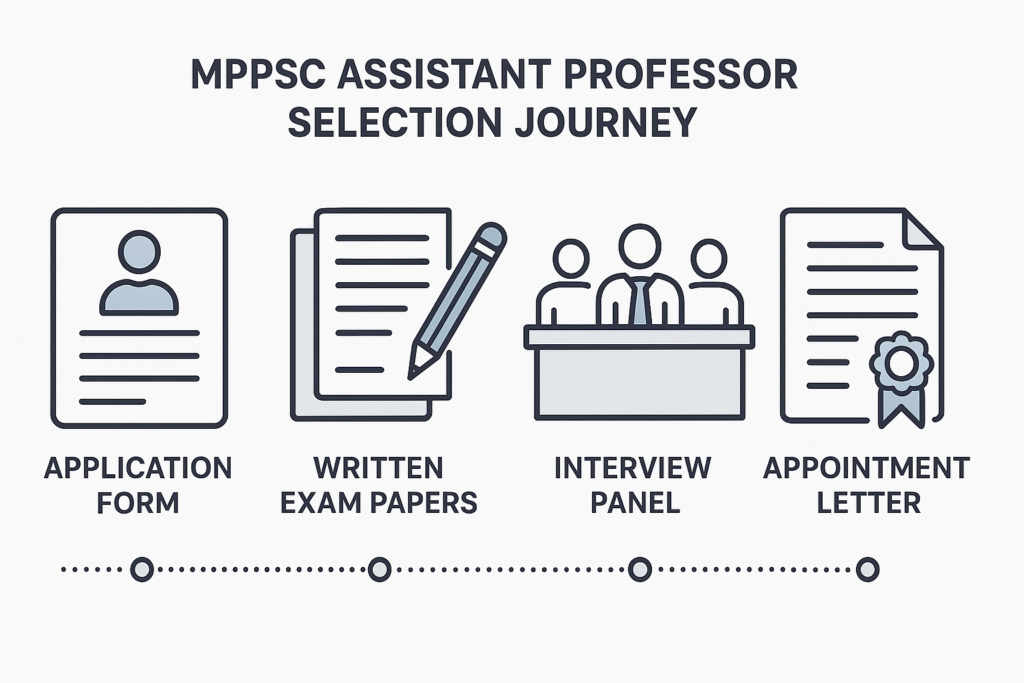
Understanding the Selection Process (What Really Decides Your Selection)
Many aspirants believe the written exam alone decides everything.
That’s only half the truth.
The MPPSC Assistant Professor Recruitment 2026 selection process evaluates candidates across multiple academic and procedural layers, not just marks.
Broadly, the process includes:
Written examination
Academic weightage (as applicable)
Interview / verification stages
The key takeaway: Consistency matters more than one good exam day.
Written Examination: How MPPSC Evaluates Knowledge (Not Rote Memory)
Nature of the Exam
Unlike competitive exams that focus on speed, MPPSC Assistant Professor exams focus on:
Conceptual clarity
Subject depth
Application of theory to teaching scenarios
This aligns with the real role of an Assistant Professor — teaching, not cramming.
Smart Preparation Insight
Instead of memorizing:
Focus on core theories
Understand why concepts matter
Link syllabus topics with real classroom relevance
Expert Insight:
Candidates with NET/PhD backgrounds often perform better because they already think analytically rather than mechanically.
Syllabus Decoding Strategy (How Toppers Actually Study)
Most candidates make the mistake of:
“Covering everything, but mastering nothing.”
Strategic Syllabus Breakdown
Divide the syllabus into:
High-weight conceptual areas
Frequently repeated themes
Teaching-oriented topics
Then:
Master Tier 1 topics deeply
Revise Tier 2 smartly
Do not ignore Tier 3, but don’t over-invest time
This approach balances depth + coverage.
Interview & Document Verification: The Silent Eliminator
Many aspirants relax after the written exam.
That’s where mistakes happen.
What MPPSC Checks Carefully
Original degree certificates
Subject equivalence
Reservation validity
Experience claims (if any)
Reality Check:
Verification is not a formality. It is a filter.
Comparison: MPPSC vs Other Assistant Professor Recruitments
| Aspect | MPPSC | Contract / University Hiring |
|---|---|---|
| Job Nature | Permanent | Temporary |
| Promotions | Structured | Uncertain |
| Pay Stability | High | Variable |
| Academic Growth | Strong | Limited |
This comparison explains why competition remains intense despite rigorous eligibility norms.
Mistakes Candidates Make AFTER Applying (Often Ignored)
Mistake 1: Stopping Preparation
Many candidates assume:
“Exam will be months away.”
But MPPSC timelines can change quickly.
Mistake 2: Ignoring Teaching Perspective
Answers written like:
Coaching notes
Exam-oriented jargon
Instead of:
Clear explanations
Academic logic
Teaching mindset matters.
Mistake 3: Poor Document Organization
Scrambling for certificates at the last moment causes:
Stress
Errors
Missed deadlines
Actionable Post-Application Plan
Here’s what a serious aspirant should do next:
Create a subject-wise revision schedule
Start answer writing practice (even short notes)
Organize all academic documents neatly
Track MPPSC updates weekly (not obsessively)
Frequently Asked Questions (FAQs)
1. Who should apply for MPPSC Assistant Professor Recruitment 2026?
Candidates with required postgraduate qualifications and teaching eligibility as per norms should apply seriously.
2. Is NET or PhD mandatory?
Eligibility depends on subject-specific rules. Candidates must carefully match qualifications.
3. Can errors be corrected later?
Only limited fields are usually editable. Core eligibility errors often cannot be corrected.
4. Is this recruitment worth attempting if I already teach as guest faculty?
Yes. This offers long-term stability and career growth.
5. How competitive is the exam?
Competition varies by subject. Strategic preparation significantly improves chances.
6. Does academic background matter during selection?
Yes. Verification and academic consistency play a crucial role.
7. What happens if subject mismatch is found later?
Even qualified candidates can be disqualified during verification.
8. How should I prepare differently from other exams?
Focus on conceptual clarity, teaching orientation, and syllabus depth.
Conclusion: More Than a Recruitment, It’s a Career Decision
The MPPSC Assistant Professor Recruitment 2026 is not just an application to fill.
It is a career direction choice.
Those who approach it casually may clear stages but stumble later.
Those who approach it strategically build long-term academic security.
Call to Action (CTA)
If you are serious about an academic career:
Apply thoughtfully
Prepare consistently
Respect eligibility rules
Remember:
One well-prepared attempt can define decades of professional life.