A complete, expert-level guide to DSSSB MTS Recruitment 2025 — eligibility, vacancy analysis, application mistakes, exam strategy, and insights to help aspirants secure Delhi government jobs.
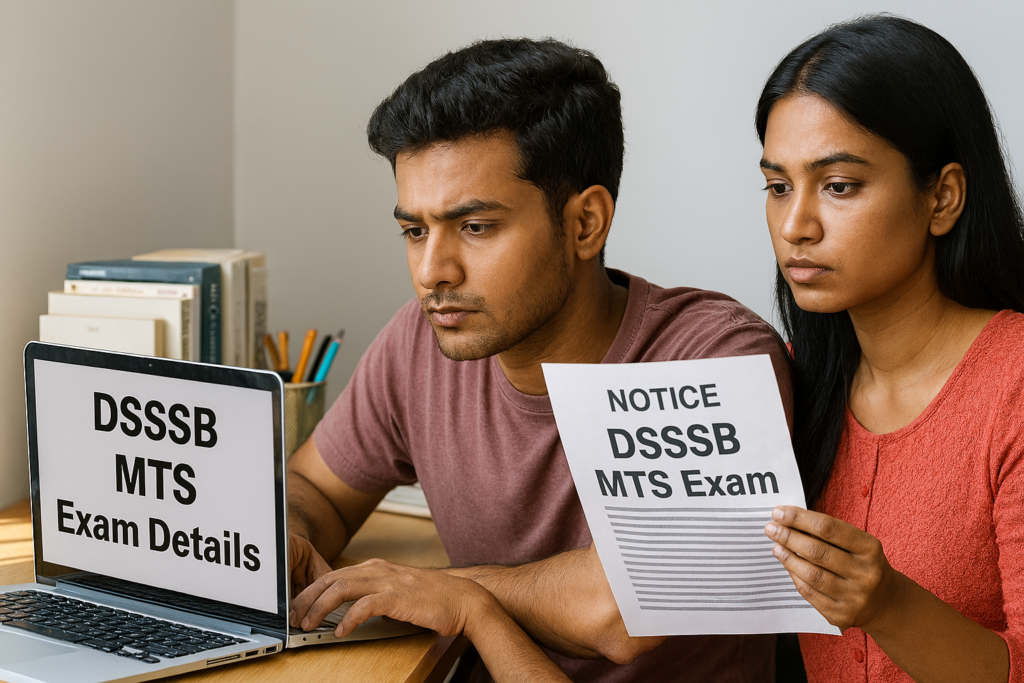
Table of Contents
Introduction
The demand for stable Delhi government jobs continues to rise, and the DSSSB MTS Recruitment 2025 has become one of the most talked-about opportunities this year. With thousands of applicants eyeing Multi-Tasking Staff posts across departments, aspirants often struggle with clarity on vacancy distribution, eligibility rules, salary structure, and selection strategy.
This guide simplifies everything using an expert, storytelling-based approach.
You’ll learn:
Realistic expectations from DSSSB MTS recruitment
Vacancy trends and their significance
Where aspirants commonly make mistakes
Eligibility rules explained with examples
Salary, job role, and career growth
A fact-based analysis that gives you an edge
Let’s begin with the core understanding every aspirant must have.
Understanding DSSSB MTS Recruitment 2025: Why It Matters
The DSSSB conducts exams for multiple Delhi government departments. The MTS (Multi-Tasking Staff) post is one of the most accessible yet competitive exams due to:
Low educational barrier (10th pass in most cases)
Large applicant volume
Steady work environment and government benefits
A Quick Scenario
Imagine a student named Rahul, working part-time to support his family. He has only completed Class 10 but dreams of securing a Delhi government job. DSSSB MTS becomes the perfect doorway for him — simple eligibility, predictable exam pattern, and long-term job security.
This is why the recruitment holds importance for lakhs of aspirants like Rahul.
APSC DSSSB MTS 2025 Vacancy Overview (Expert Breakdown)
The vacancies are announced department-wise, and each department has different job responsibilities. Instead of just listing posts, here’s a strategic analysis of what the numbers mean:
1. Large Vacancies = High Competition, Not Easy Selection
A high number of posts doesn’t guarantee easy selection. Historically:
DSSSB exams receive 6–12 lakh applications
MTS posts attract 3x higher response compared to clerk-level posts
Cut-offs fluctuate sharply depending on the department
2. Departments With Higher Demand Fill Faster
Aspirants prefer departments such as:
Education
Urban Development
Municipal Corporations
Because they offer predictable work schedules, timely promotions, and employee welfare schemes.
3. Why Vacancy Analysis Matters for You
Because strategy depends on post preference:
Departments with fewer seats = tough cut-offs
Departments with many seats = moderate chances
Technical departments = fewer competitors
Understanding this helps aspirants prioritise posts wisely.
Eligibility Criteria for DSSSB MTS 2025 (Explained Simply)
Even though DSSSB lists eligibility clearly, candidates still make avoidable mistakes during application.
Here’s a simplified breakdown:
1. Educational Qualification
Most MTS posts require:
10th Pass (from a recognized board)
But certain technical departments may demand:
ITI / Trade Certificate
Technical experience certificates
Example:
If the Department of Health requires an MTS (Ward Boy), they may ask for hospital-based experience.
If the Municipal Corporation needs a Sweeper MTS, they may prioritize candidates with sanitation experience.
Always cross-check department-specific requirements.
2. Age Limit
Typical age criteria:
18 to 27 years (general category)
Relaxations:
OBC: +3 years
SC/ST: +5 years
PwD: +10 years
Government Employees: Up to 40 years (varies)
Case Example:
Meena, a 29-year-old OBC candidate, can still apply for MTS posts because her category gives her 3 years relaxation.
3. Nationality
Applicant must be:
A citizen of India
Some posts may allow individuals from territories under Delhi jurisdiction
This is straightforward but often overlooked during documentation.
Job Role & Responsibilities (Realistic View)
DSSSB MTS roles differ department to department.
Common tasks include:
Assisting in office activities
File movement and documentation
Minor maintenance work
Data entry or registry tasks
Helping with departmental operations
Assisting senior officials
Why This Section Matters?
Most aspirants apply without understanding the job nature.
Knowing the responsibilities helps avoid future dissatisfaction.
Salary Structure of DSSSB MTS 2025 (Expert-Level Breakdown)
DSSSB follows 7th Pay Commission:
Pay Level: 1 / 2
Basic Pay: ₹18,000 – ₹19,900
HRA: 24% (Delhi)
DA: Updated regularly
TA + Other Allowances
Estimated In-Hand Salary:
₹25,000 – ₹32,000 per month depending on the department.
Long-Term Benefits:
Job security
Medical facilities
Pension under NPS
Promotions to Senior Assistant posts
Skill-based increments
What Makes DSSSB MTS Difficult?
1. High Applicant Volume
The biggest challenge is not the syllabus — it’s the competition.
2. Speed-Based Exam
Questions are relatively easy, but solving 100 questions in 90 minutes requires:
Accuracy
Time control
Zero guesswork in tricky GK questions
3. Smart Revise + Mock Strategy Wins
Top scorers are those who practice 40–60 mocks and understand pattern-based questions.
TABLE: DSSSB MTS Eligibility Summary
| Category | Requirement |
|---|---|
| Education | 10th Pass (minimum) |
| Age Limit | 18–27 years (general) |
| Pay Level | Level 1 / 2 |
| In-Hand Salary | ₹25,000–₹32,000 |
| Departments | Education, MCD, Health, UD Department |
| Selection Stages | Written Exam + Document Verification |
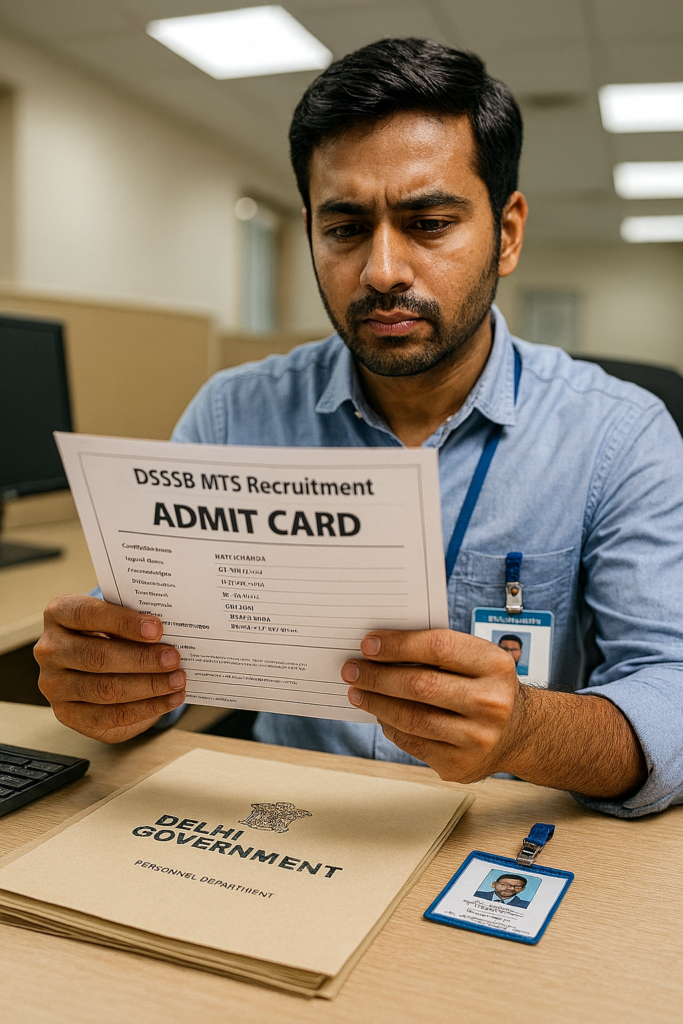
DSSSB MTS Selection Process 2025
Most aspirants underestimate the selection process, assuming MTS posts require minimal effort. But DSSSB maintains a strict, merit-based filtering mechanism.
Here’s how the selection pipeline works:
Stage 1: Written Examination (MCQ-Based)
This is the only deciding stage for most MTS posts.
Marks scored in this exam directly influence the final merit list.
The paper consists of:
General Awareness
Reasoning
Quantitative Aptitude
English Language
Hindi Language
Each section carries equal weightage, making balance crucial.
Stage 2: Document Verification
Candidates shortlisted from the written exam must present:
10th Pass Certificate
Category Certificate
Identity Proof
Experience Certificate (if applicable)
Department-Specific Documentation
Why Selection is Tougher Than It Looks?
Because a difference of just 3–6 marks can change your rank dramatically due to massive applicant numbers.
DSSSB MTS Syllabus 2025 (Explained with Examples)
Instead of listing topics, here is an analysis-oriented explanation:
1. General Awareness (High Weightage, High Risk)
This is the most unpredictable section.
Includes:
Polity basics
Delhi Govt schemes
Current Affairs
Geography
History
Sports
Static GK
Example Question Pattern:
“Which Delhi department recently launched a public sanitation initiative?”
These types require both current affairs + state-specific knowledge.
2. Reasoning Ability (Scoring Section)
Most students clear cut-off because of reasoning.
Topics:
Number Series
Analogies
Coding-Decoding
Directions
Blood Relation
Odd One Out
Example:
If A is the brother of B, and B is the mother of C, how is A related to C?
3. Quantitative Aptitude (Moderate Difficulty)
Mostly Class 8–10 level maths:
Percentage
Profit & Loss
Simple Interest
Ratio
Averages
Simplification
Expert Tip:
Focus on simplification and percentage conversions — these contribute to 60% of repeated questions.
4. English Language (Easy to Moderate)
Topics include:
Reading Comprehension
Error Detection
Synonyms/Antonyms
Fill in the Blanks
Sentence Rearrangement
Example:
Spot the error:
“Each of the boys have a notebook.”
5. Hindi Language (Straightforward)
Topics:
व्याकरण
समास
विलोम
पर्यायवाची
गद्यांश
Example:
‘आशा’ का विलोम क्या है?
Exam Preparation Strategy (Science-Backed Approach)
This is where most blogs fail — they give generic tips.
Here is a practical, psychological approach used by toppers:
1. Build a 60-Day Plan With Micro-Targets
Why 60 Days?
It aligns with:
Revision cycles
Memory retention
Mock test improvement curve
Sample Breakdown:
Day 1–20: Basics + Concept clarity
Day 21–40: Practice & accuracy
Day 41–60: Mock tests + revision
2. Reasoning + GK Combo Strategy
These two sections decide final rank.
Reasoning = Accuracy booster
GK = Rank maker
Study both daily for at least 60 minutes each.
3. Solve 40–60 Mock Tests
Data shows that candidates who solve over 50 mocks improve their final score by 18–22 marks.
Mocks help with:
Time management
Pattern recognition
Eliminating poor guesswork
Building muscle memory
4. Make a Personal Error Log
Track:
Repeated mistakes
Weak topics
Accuracy drop areas
This is the fastest way to improve.
Common Mistakes DSSSB MTS Aspirants Make
99% of students commit at least one of these:
1. Studying GK Randomly
GK should be structured:
Delhi-based news
National schemes
Static facts
2. Ignoring Cut-Off Trends
Students assume the exam is easy.
But MTS cut-offs often cross:
75–85+ for general category
3. Not Practicing Language Sections
English/Hindi appear easy but contribute heavily to rank.
4. Overconfidence in Reasoning
Reasoning becomes dangerous if one question consumes 4–5 minutes.
5. Leaving Mock Tests for Last Week
Exam toppers start mocks at least 6 weeks before exam day.
Case Comparison: High-Ranked vs Low-Ranked Aspirant
| Criteria | High Rank Candidate | Low Rank Candidate |
|---|---|---|
| Mock Tests | 50+ | 5–10 |
| Error Log | Maintained | None |
| GK Study | Structured | Random |
| Time Management | Strong | Weak |
| Strategy | Balanced | Subject-biased |
This table shows why preparation strategy matters more than the syllabus itself.
Cut-Off Insights: Realistic Expectations
Factors affecting cut-off:
Vacancy volume
No. of applicants
Difficulty level
Department preference
Normalization
General Prediction Range:
75–85+ (General category)
68–78 (OBC)
60–70 (SC/ST)
Table: DSSSB MTS 2025 Exam Pattern
| Section | Questions | Marks | Difficulty Level |
|---|---|---|---|
| General Awareness | 20 | 20 | Moderate–High |
| Reasoning | 20 | 20 | Easy–Moderate |
| Quantitative Aptitude | 20 | 20 | Moderate |
| English | 20 | 20 | Easy |
| Hindi | 20 | 20 | Easy |
| Total | 100 | 100 | Balanced Difficulty |
FAQs
1. What is the minimum qualification for DSSSB MTS 2025?
10th pass from a recognized board.
2. What is the age limit for MTS?
18–27 years (with relaxations for reserved categories).
3. Is there an interview for DSSSB MTS?
No, selection is based solely on the written exam.
4. How can I improve my GK for MTS?
Focus on Delhi news, national schemes, and static GK.
5. How many mocks should I attempt?
At least 40–60 full-length tests.
6. Is Hindi compulsory?
Yes, Hindi is a compulsory section carrying 20 marks.
7. What is the in-hand salary?
₹25,000–₹32,000 depending on allowances.
8. How many vacancies are expected?
Vacancies vary by department; official notification provides the final list.
Conclusion
The DSSSB MTS Recruitment 2025 is one of the most accessible yet competitive government job opportunities. With structured preparation, mock test discipline, and consistent revision, any Class 10 qualified aspirant can secure a stable future in Delhi government departments.
Success depends on understanding the exam—not just reading the syllabus.
Call to Action (CTA)
If this guide helped you, share it with other DSSSB aspirants. Begin your preparation today, follow the strategy, and move confidently toward securing your Delhi government job.