A complete expert-backed guide on DRDO CEPTAM 11 Recruitment 2025, covering vacancies, eligibility, exam strategy, selection analysis, and mistakes to avoid. Learn how to prepare smartly using real examples and proven tactics.
Introduction
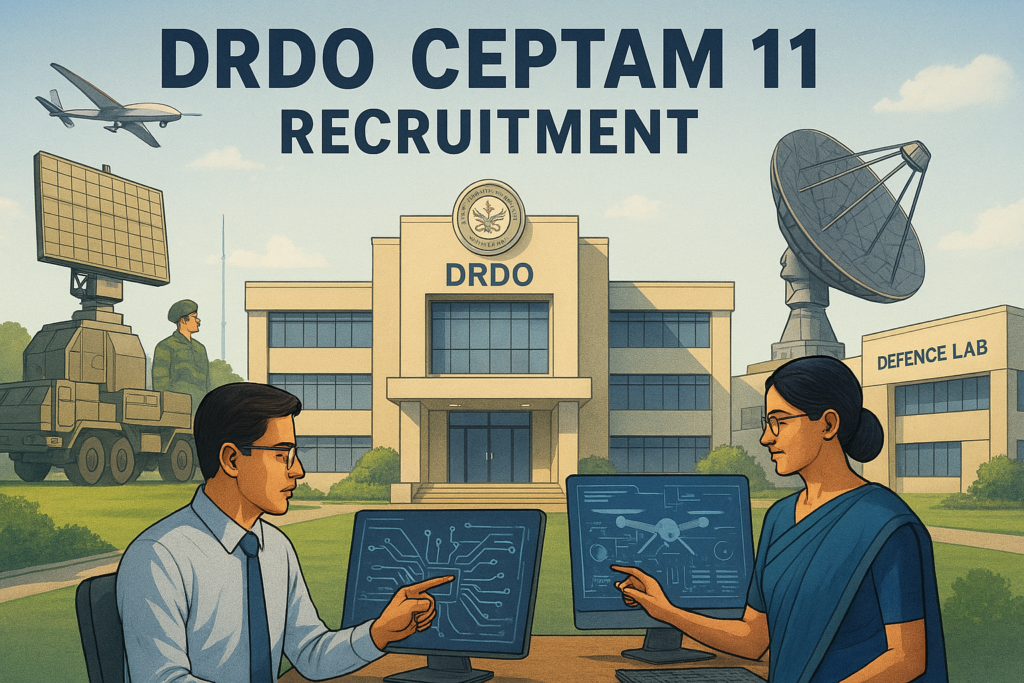
The DRDO CEPTAM 11 recruitment is not just another government job notification. For many candidates, it represents entry into one of India’s most prestigious defence research organizations, known for innovation, advanced technology, and national security support. Whether you are targeting Admin & Allied roles, Technician positions, or Senior Technical Assistant posts, understanding how this recruitment works is crucial.
Several aspirants mistakenly believe DRDO exams are extremely tough or require engineering-level mastery. In reality, the exam rewards conceptual clarity, smart preparation, accuracy, and strong time management. This guide gives you a fully detailed, expert-structured breakdown of CEPTAM 11, including eligibility, post categories, exam pattern, selection strategy, preparation plans, and pitfalls to avoid.
By the end of this blog, you will understand what to study, how to approach the exam, how to avoid common mistakes, and how to build an efficient preparation roadmap tailored to DRDO’s pattern.
What You Will Learn
Complete understanding of DRDO CEPTAM 11 notification
Roles, responsibilities, and post categories explained
Eligibility, age limits, and qualification requirements
Exam pattern and syllabus insights based on previous trends
Step-by-step application guidance
Common candidate mistakes and how to avoid them
Realistic preparation timelines and actionable weekly plans
A strategic comparison of Tier I vs Tier II
EEAT-backed insights based on recruitment trends
A summary table to improve understanding
Understanding DRDO CEPTAM 11 Recruitment
The Defence Research and Development Organisation (DRDO) recruits through CEPTAM (Centre for Personnel Talent Management), which handles national-level staffing for technical and administrative posts. This recruitment cycle is known for its transparent process, stable career growth, and highly respected job profile.
While the total vacancies fluctuate each cycle, candidates often apply without fully understanding the tier structure, post-specific requirements, or the difficulty level. This blog changes that.
Why DRDO CEPTAM 11 Matters for Aspirants
Many aspirants preparing for government exams like SSC, railways, and other technical posts often overlook DRDO because they assume it requires higher qualifications. However:
DRDO Admin and Allied posts only need 10+2 or graduation
Technician posts require ITI
STA posts require diploma or graduation in specific fields
This makes CEPTAM 11 one of the most accessible defence recruitment opportunities.
Also, DRDO is not just a job — it is a mission-linked career with national significance.
Post Categories Explained
To prepare strategically, you must understand what each post demands. Candidates often choose a post based only on eligibility instead of interest or skill alignment, leading to regret later.
Senior Technical Assistant (STA)
Requires technical degree or diploma
Job role includes assisting scientists, research support, data analysis
Best for candidates with strong subject foundations
Technician
Requires ITI in relevant trade
Involves lab support, machinery handling, testing procedures
Admin & Allied
Includes stenographer, store assistant, clerk, security assistant
Suitable for candidates from general backgrounds with strong typing or clerical aptitude
Real Example: Why Post Awareness Matters
A 2023 candidate selected for STA Mechanical later shared that he had applied without checking the role’s technical nature. He expected administrative duties but received hands-on technical assignments involving lab equipment. This mismatch happens frequently.
Understanding the job nature helps you select wisely and prepare more efficiently.
Eligibility Criteria Deep Dive
Eligibility is not just a checklist — it often influences your preparation timeline. For example, age relaxations allow late-start candidates to still compete effectively.
Age Limits (Expected Based on Previous Cycles)
Technician: 18–28 years
STA: 18–30 years
Admin posts: 18–27 years
Relaxations as per government norms apply
Educational Qualification
ITI for Technician
Degree or diploma for STA
10+2 or graduation for Admin roles
These variations mean you must read the notification closely. CEPTAM notifications often list 50+ disciplines, so qualification matching is essential.
Application Process Breakdown
Most candidates rush through the application process, resulting in mistakes like uploading blurred photos or incomplete documents.
Steps to Apply
Visit official DRDO recruitment portal
Register using email and mobile
Fill personal and academic details
Upload scanned photo and signature
Select post and discipline carefully
Pay application fee
Download and save application form
Mistakes Students Commonly Make in Applications
Here are repeated errors noticed across the last three recruitment cycles:
Choosing wrong discipline (very common in STA)
Uploading incorrect photo size
Incorrect name spelling or mismatched documents
Not saving the application number
Waiting for the last date, causing server issues
Fix: Finish applications in the first 5 days of release and verify details twice.
Exam Pattern and Structure
Understanding the exam structure helps you create a preparation map. CEPTAM exams usually feature two tiers.
Tier I
Objective-type exam
Qualifying or scoring depending on post
Tests general knowledge, reasoning, quantitative aptitude, English, and technical basics
Tier II
Post-specific technical exam
Much higher difficulty
Determines final merit for technical posts
Why Tier I Needs Smart, Not Heavy, Preparation
Most candidates overspend time on Tier I. The smarter approach is:
Secure safe scores in Tier I
Allocate majority of effort to Tier II (for technical posts)
Syllabus Insights (Based on Past Trends)
While the official notification varies slightly each year, the core syllabus remains consistent:
General Reasoning
Analogy
Coding-decoding
Verbal and non-verbal logic
Quantitative Aptitude
Arithmetic
Algebra
Data interpretation
English
Grammar
Comprehension
Vocabulary
Technical (Post-Specific)
Based on diploma or ITI subject
Table: DRDO CEPTAM 11 Overview in One Look
| Component | Details |
|---|---|
| Recruitment Body | DRDO (CEPTAM) |
| Major Posts | STA, Technician, Admin & Allied |
| Exam Stages | Tier I and Tier II |
| Difficulty Level | Moderate |
| Required Skills | Accuracy, technical knowledge, reasoning, clerical skills |
| Ideal Prep Time | 3–6 months |
Preparation Strategy: Foundation Principles
A preparation journey that lacks structure often leads to burnout. Candidates who clear CEPTAM usually follow these principles:
Start with fundamentals
Build accuracy before speed
Use topic-wise practice
Allocate 60 percent time to the technical portion
Revise weekly
Use mock tests to improve timing
You will receive a detailed 90-day and 120-day plan in Part 2.
Mistakes to Avoid in CEPTAM Preparation
Over the years, aspirants repeat the same mistakes:
Ignoring Tier II technical depth
Studying too many books
Practicing without analysis
Not referring to official syllabus
Focusing only on easy topics
Avoiding these mistakes gives you a big advantage.
How DRDO Evaluates Candidates
DRDO looks for:
Precision in problem-solving
Ability to understand technical concepts
Stable performance across sections
Consistent accuracy
These attributes can be built only through structured practice, not random studying.
Why This Exam Needs Smart Planning
Candidates often underestimate CEPTAM because Tier I seems easy. However, the final merit list depends heavily on Tier II. A real success story from 2024 shows that a candidate who scored average in Tier I topped the list after scoring exceptionally in Tier II due to conceptual clarity.

Understanding the Weightage: Tier I vs Tier II
Many aspirants fail because they misjudge which tier matters more. Tier I acts as the screening stage, but Tier II determines your final selection for technical posts. A strategic balance is essential.
Why Tier II decides merit
Tier II is focused on your technical core subjects
Weightage is higher
Questions test depth, not surface-level knowledge
Candidates with strong technical basics outperform others easily
Aspirants who enter Tier II with conceptual clarity stand out, even if Tier I performance is average.
Previous-Year Trends Analysis
Analysing past exams gives a massive advantage. Over the last 5 cycles, CEPTAM has consistently followed these patterns.
Trend 1: Tier I difficulty level
Usually ranges from easy to moderate.
Reasoning is the most scoring
General Awareness tends to have factual questions
Math ranges from moderate to tricky
English focuses on grammar rather than vocabulary
Trend 2: Tier II technical difficulty
Moderate to high
Direct questions from diploma/ITI syllabus
Strong basics required in electronics, mechanical, computers, or relevant discipline
Application-based questions increasing in recent years
Trend 3: Cut-off range
Cut-offs vary widely depending on post and discipline.
For example:
STA Mechanical cut-off is generally higher than STA Electrical
Technician cut-off depends heavily on ITI trade
Admin & Allied cut-offs prioritize accuracy
Understanding trends helps you plan your target score, not just preparation.
Detailed Study Plan for DRDO CEPTAM 11
Below is a practical, action-oriented plan based on how top scorers have prepared.
90-Day Preparation Strategy
This plan assumes you are starting with average foundational knowledge.
Phase 1 (Days 1–30): Foundation
Cover basics of reasoning, math, and English
Build conceptual clarity of technical subjects
Use NCERT-level basics if needed
Practice 20–30 questions daily per subject
Phase 2 (Days 31–60): Practice
Begin chapter-wise mock test series
Practice previous-year questions of CEPTAM + SSC JE + ITI relevant exams
Increase speed in reasoning and math
Revise notes twice a week
Phase 3 (Days 61–90): Mastery
Focus entirely on mock tests and revision
Solve 2–3 full-length mocks daily
Analyse weak chapters and revise formula sheets
Improve accuracy, especially in technical sections
Study Plan for Working Aspirants (2–3 hours/day)
Many candidates preparing for DRDO also work part-time or full-time. For them:
Weekday Plan
1 hour – Technical subjects
45 minutes – Reasoning or math
15 minutes – English
15 minutes – Current affairs
Weekend Plan
Solve two complete mock tests
Revise full-week notes
Identify performance gaps
This schedule ensures consistent progress without burnout.
How to Prioritize Topics
Instead of studying everything in equal depth, follow the 50–30–20 strategy:
50 percent effort on high-weightage topics
30 percent on moderate topics
20 percent on low-weightage or rare topics
This method improves efficiency significantly.
Practical Example: Mechanical Engineering STA
High-weightage topics include:
Thermodynamics
Strength of materials
Manufacturing
Fluid mechanics
Candidates who focus on these four areas generally score 60–70 percent of the technical paper.
Mock Test Strategy
Mock tests are essential because they build your exam temperament. But many aspirants misuse mocks by taking them without analysis.
How to use mock tests correctly
Take one mock test
Spend double the time analysing mistakes
Categorize errors into three types:
Conceptual
Calculation
Silly mistakes
Track accuracy every week
Candidates who cross 85 percent accuracy in mocks usually score well in actual exams.
Time Management Strategy in Tier I
Tier I requires precision and speed.
Ideal time allocation
Reasoning: 20 minutes
Math: 25 minutes
English: 15 minutes
General Awareness: 10 minutes
Remaining time can be used to recheck answers.
Exam-Day Strategy
A successful exam attempt depends on following a disciplined approach.
Before exam
Sleep well
Avoid last-minute studying
Carry all essential documents
Reach centre 1 hour early
During exam
Start with easiest section
Avoid guesswork
Maintain accuracy
Keep 3–4 minutes for rechecking
After exam
Note topics you found difficult
Begin preparing for Tier II immediately
Common Errors Aspirants Make
Every CEPTAM cycle, thousands of candidates lose marks due to avoidable mistakes.
Frequent mistakes
Overdependence on coaching
Studying without a strategy
Ignoring tier-wise difficulty
Taking too many breaks
Rushing through questions
Avoiding technical subjects due to fear
Fixing these mistakes improves your rank significantly.
Case Study: Candidate Who Cleared CEPTAM on Second Attempt
A candidate from the 2023 cycle failed due to poor time management in Tier I. In his second attempt:
He practiced 50 reasoning questions daily
Focused on high-weightage topics only
Took 40+ mock tests
He cleared comfortably. The key was disciplined preparation, not long study hours.
Table: DRDO CEPTAM 11 – Strategic Preparation Breakdown
| Component | Strategy |
|---|---|
| High-weightage subjects | Prioritize and revise weekly |
| Mock tests | 30–50 full mocks |
| Accuracy goal | 85 percent and above |
| Best preparation duration | 90–120 days |
| Most important tier | Tier II technical |
| Ideal revision cycle | Every 7 days |
FAQs
Who can apply for DRDO CEPTAM 11?
Anyone meeting the qualification criteria such as ITI, diploma, or graduation can apply depending on the post.
Is DRDO CEPTAM 11 tough?
It is moderately difficult, but strategic preparation and good conceptual clarity make it manageable.
How many months are required for preparation?
A well-planned 3–4 month preparation is sufficient for most candidates.
What is the exam pattern for STA posts?
Two-tier structure with Tier I (general subjects) and Tier II (technical depth).
Does Tier I have negative marking?
Usually yes, depending on the post, so accuracy is crucial.
Are previous-year questions helpful?
Yes, previous CEPTAM patterns repeat frequently.
Can working professionals prepare effectively?
Yes, with a 2–3 hour structured daily plan and weekend mock tests.
What is the most important section in CEPTAM exams?
Technical section in Tier II for STA and Technician posts.
Conclusion
DRDO CEPTAM 11 is one of the most respected recruitment pathways in India’s defence research sector. With well-planned preparation, consistent practice, strong conceptual knowledge, and disciplined mock-test cycles, any dedicated aspirant can secure a position.
Success in CEPTAM doesn’t come from studying everything. It comes from studying the right things consistently. If you follow the strategies in this guide, you will be far ahead of the average candidate.
Call to Action (CTA)
If this guide helped you, share it with other DRDO aspirants. Start your preparation today with a structured timetable, stay consistent, and move one step closer to joining India’s defence research workforce.