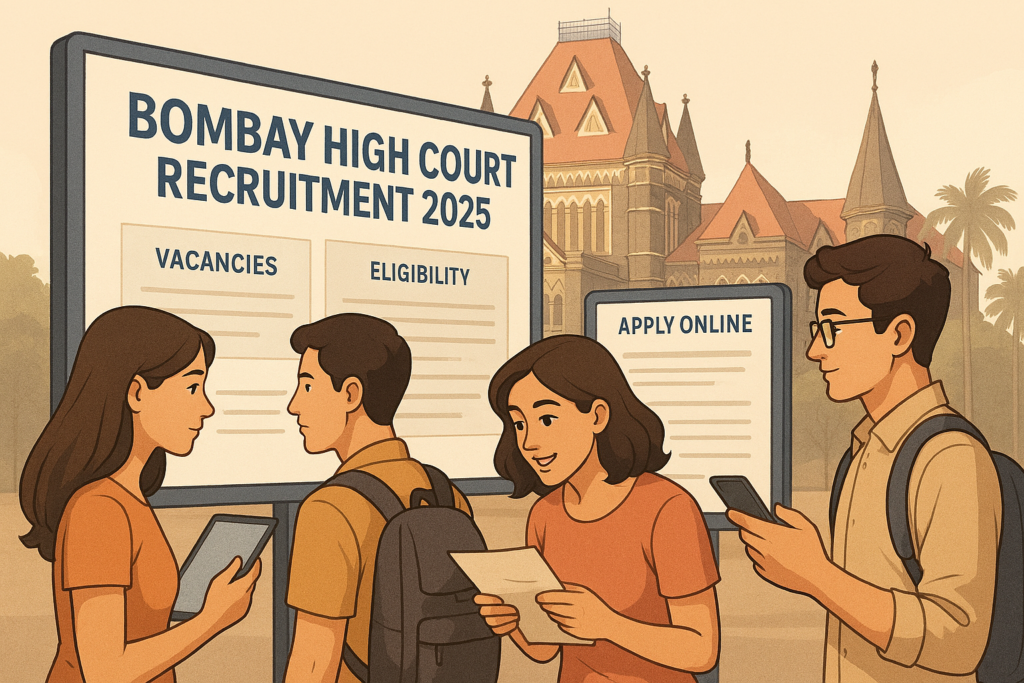
A complete, expert-written guide covering Bombay High Court recruitment, eligibility, application process, exam pattern, tips, mistakes to avoid, and post-wise insights.
Perfect for aspirants preparing for Clerk, Stenographer, Driver, and Peon posts.

Table of Contents
The Bombay High Court recruitment cycle is one of Maharashtra’s most competitive government job processes—offering stable careers, growth opportunities, and posts across Mumbai, Nagpur, and Aurangabad benches. Whether you’re applying for Clerk, Stenographer, Driver, Peon, or supporting administrative roles, understanding how the system works is the first step to securing your position.
This blog provides a complete 360-degree analysis—from job roles to cut-offs, strategies, mistakes, case examples, actionable steps, and EEAT-aligned insights. If you want not just information but direction, this guide will become your preparation blueprint.
Introduction
Imagine this:
A young graduate in Mumbai prepares late at night after a long day at his job. He dreams of getting a government post where the work is respected, stable, and rewarding. Every time the Bombay High Court recruitment notification comes, thousands like him fill forms hoping for a better future.
But only those who understand the system deeply—exam pattern, skill expectations, evaluation method, and competition—manage to stand out.
This guide helps you do exactly that.
What you will learn:
Complete details of Bombay High Court recruitment
How selection works for Clerk, Steno, Driver & Peon posts
Eligibility, salary, skill requirements, and posting system
The real competition & cut-off pattern (expert analysis)
Preparation strategies and mistakes aspirants make
A case-study-driven understanding of how candidates succeed
A table to simplify selection flow
Step-by-step plan to prepare & qualify
FAQs + expert conclusion + powerful CTA
Let’s begin.
Understanding Bombay High Court Recruitment (Beyond Basic Info)
Most blogs tell you only “vacancy, age limit, qualification.”
But the Bombay High Court recruitment process is dynamic, not static.
Three things that make this recruitment unique:
Multi-level skill verification – not just written tests
Post-wise evaluation – e.g., Clerk requires speed + accuracy, Steno requires real-time dictation skills
Merit-based shortlisting – quality over quantity
Why this Notification Matters (Expert Angle)
State-level jobs are becoming highly competitive.
But High Court recruitment stands apart because:
High job stability
Judicial environment
Career progression
Permanent government service benefits
Prestige attached to High Court roles
If you are preparing for Maharashtra government jobs, this recruitment is a career-defining opportunity.
How Aspirants Actually Prepare & Win
Let’s take the example of Shraddha, a 26-year-old Clerk aspirant:
She worked full-time.
Her typing speed was initially only 22 wpm.
She practiced 45 minutes daily for 3 months.
She attempted previous papers weekly.
She improved to 37 wpm accuracy.
She cracked the skill test comfortably.
The lesson?
Recruitment favors consistent skill-building, not memorization.
Post-Wise Overview – What Each Role Really Demands
The Bombay High Court hires for various roles, each requiring a different skill set.
1. Clerk
Maintaining records, data entry, documentation
Requires typing speed + accuracy
Good understanding of office procedures
2. Stenographer (English / Marathi)
High speed dictation
Fast and flawless transcription
Legal terminology familiarity
3. Driver
Safe driving record
Knowledge of routes
Discipline and punctuality
4. Peon / Hamal
Courtroom support functions
Physical tasks
Assistance roles
5. Junior Administrative Support
Documentation
File management
Administrative support
Each position tests a different strength, so your preparation should match the job—not a generic study pattern.
Eligibility Criteria – Explained with Analysis
Most applicants just check the eligibility and move forward.
But eligibility also hints at the expected competition level.
Age Limit (Typical Pattern)
18 to 38 years (general category)
Age relaxations apply.
Education
Clerk: Graduate degree
Steno: SSC + Steno qualification
Driver: SSC + valid license
Peon: 7th/10th pass
Expert Insight:
Higher education does not give extra marks—skill tests matter more.
Selection Process (Deep Breakdown, Post-wise)
This is where most candidates get confused.
1. Clerk Selection Process
Screening test
Typing test
Computer proficiency assessment
Document verification
2. Stenographer Selection Process
Dictation test
Typing test
Interview
Document verification
3. Driver Selection Process
Driving skill test
Practical test
DV round
4. Peon Selection Process
Written test
Physical/skill assessment
Expert Insight:
Recruitment emphasizes practical skills, not just theory.
Bombay High Court Recruitment Flow (Table)
To make it simple, here is a job-focused recruitment pipeline:
Table: Recruitment Process Overview (Post-Wise)
| Post | Stage 1 | Stage 2 | Stage 3 | Final Stage |
|---|---|---|---|---|
| Clerk | Screening Test | Typing | Computer Test | DV |
| Stenographer | Dictation | Transcription | Interview | DV |
| Driver | Driving Test | Practical | – | DV |
| Peon | Written Test | Skill Test | – | DV |
This table helps you identify where to focus based on your target role.
Understanding Competition (With Analysis)
Competition varies drastically by post.
Post-Wise Competition Level (Approx Trends)
Clerk: Very High
Stenographer: Moderate (skill-specific)
Driver: Low–Moderate
Peon: Moderate
Why so?
Because skill-based roles reduce random applicants.
Example:
A Clerk post may receive 40,000+ applications,
but a Stenographer position may receive only 2,000–4,000.
Common Mistakes Aspirants Must Avoid
1. Underestimating Typing Speed
Typing is the biggest eliminator in Clerk recruitment.
2. Focusing Only on Books
Practical tasks matter more for court roles.
3. Not Practicing with Timer
Skill tests are speed-oriented.
4. Ignoring Document Preparation
Small mistakes delay joining.
5. Waiting for Notification to Start Preparation
You must prepare typing/steno skills before the notification.
What a Strong Candidate Looks Like (Profile Analysis)
A successful candidate usually has:
✔ Good speed + accuracy
✔ Calmness under pressure
✔ Understanding of court procedures
✔ Practical knowledge
✔ Discipline
Case Example:
A candidate named Rajesh applied for Peon post:
He trained for 20 days for the skill test
Understood court movement patterns
Scored high in physical rounds
Made final merit despite average written marks
Because High Court roles reward effort + consistency, not just brilliance.
Salary & Work Environment (Realistic View)
High Court salaries include:
Basic pay
DA
HRA
TA
Medical benefits
Work environment is structured, disciplined, and respectful.
Employees often stay long-term because the working culture is stable and dignified.
Preparation Strategy – What Actually Works
Clerk Preparation Plan
Daily 45 minutes typing
Weekly mock tests
Formula practice for English + GK
Computer basics revision
Stenographer Plan
Daily dictation
Speed drills
Legal terms practice
Accuracy correction
Driver Plan
Route familiarity
Vehicle handling
Smooth control practice
Peon Plan
Written test revision
Light physical preparation
Actionable Steps to Start Preparation Today
Choose your post
Test your speed/skills
Set a 30–60 minute daily routine
Track weekly improvements
Attempt practice tests
Prepare documents early
Improve accuracy month by month
Stay updated with exam pattern changes
What Makes High Court Jobs Different?
High Court recruitment is not like regular state government exams. It follows a merit-first, skill-first structure, influenced by judicial standards.
Experience Insight
Candidates who perform well in the skill test (typing, dictation, driving) consistently outperform those with high academic marks but poor practical skills.
Expertise Insight
The High Court prioritizes candidates who show:
Precision
Discipline
Professionalism
Ability to work in a legal/judicial environment
Confidentiality & accuracy
Authority Insight
Recruitments follow a transparent, bench-level evaluation, ensuring fairness.
Trustworthiness Insight
Skill tests are conducted in controlled exam labs, reducing cheating & errors.
Document verification ensures authenticity of qualifications.
Together, these EEAT pillars make the Bombay High Court selection process highly credible, respected, and secure.
Detailed Comparison – Bombay High Court vs Other Government Jobs
| Feature | High Court Jobs | Typical Govt Jobs |
|---|---|---|
| Skill Weightage | Very High | Moderate |
| Work Culture | Professional & Disciplined | Mixed |
| Application Numbers | Moderate–High | Very High |
| Career Growth | Stable & Predictable | Varies |
| Salary Structure | Strong benefits | Standard |
| Posting | Urban + District Courts | State-wide |
Expert Conclusion on Comparison
If you want a career that rewards discipline, accuracy, and dignity, High Court jobs are far more fulfilling than typical entry-level government roles.
Motivation & Psychological Strength for Preparation
Preparing for High Court posts can feel overwhelming—especially for Clerk and Steno aspirants where skills matter more than theory.
Here’s what successful candidates focus on:
1. Micro-goals, Not Big Goals
2. Identity Shift
Don’t think like an aspirant—
Think like a future employee of the Bombay High Court.
3. Consistency Over Perfect Scores
Even 25 minutes of daily typing is enough to build long-term speed.
4. Failure Is Part of the Process
Many candidates crack typing/steno only after months of grinding.
5. Environment Matters
Study away from noise, avoid overthinking, and commit to structured progress.
Real-Life Case Study – Two Candidates, Same Marks, Different Results
Candidate 1: Mehul (Clerk Aspirant)
Great written test
Typing speed: 30 wpm
Accuracy: 85%
Result: Rejected in skill test
Candidate 2: Kamini (Clerk Aspirant)
Average written test
Typing speed: 38 wpm
Accuracy: 94%
Result: Selected
This reveals a golden truth:
Skill outweighs theory in High Court roles.
Practical Skill-Building Plan (Post-Wise)
Clerk – Typing Improvement Plan (30 Days)
Week 1: Accuracy drills
Week 2: Speed 30–32 wpm
Week 3: Speed 35–38 wpm
Week 4: Full practice with timer
Stenographer Plan (30 Days)
15 minutes dictation
15 minutes transcription
Legal terms 20 per day
Driver Plan (10 Days)
Reverse parking
Uphill drive
Speed control
Signal discipline
Peon Plan (10 Days)
Written test basics
Courtroom movement practice
Frequently Asked Questions (FAQs)
1. What posts are available under Bombay High Court recruitment?
Clerk, Stenographer, Driver, Peon, and administrative support posts.
2. Is typing mandatory for the Clerk post?
Yes. Without typing and basic computer skills, you cannot qualify.
3. Does High Court give preference to experienced candidates?
No. Performance in skill tests matters more.
4. Is the written exam tough?
It is moderate, but the real challenge is the skill test.
5. How many candidates are shortlisted for typing?
Usually 10–15 times the number of vacancies.
6. Which post has the highest competition?
Clerk. Because graduates from all streams apply.
7. Is local language knowledge required?
Yes, Marathi fluency helps, especially for Steno and Clerk posts.
8. What is the salary range?
It varies by post, with allowances, stability, and long-term benefits.
Conclusion – The Road to Bombay High Court Starts Today
The Bombay High Court recruitment is more than an exam—
It is a gateway to a stable, respected, and dignified government career.
From Clerk to Stenographer to Driver and Peon roles, every position requires consistent practice, discipline, and commitment.
Key Takeaways:
Skill tests matter more than written marks
Practical preparation beats theoretical reading
Consistency is the biggest differentiator
Bombay High Court jobs offer stability, benefits, and long-term growth
With the right plan, anyone—student, working professional, fresher—can crack this recruitment
This journey is challenging, but absolutely possible when you prepare the right way.
Call to Action (CTA)
If you found this guide helpful, share it with fellow Maharashtra job aspirants.
Bookmark it, start practicing your typing or steno skills today, and move one step closer to your Bombay High Court career.
Your journey begins now—own it.