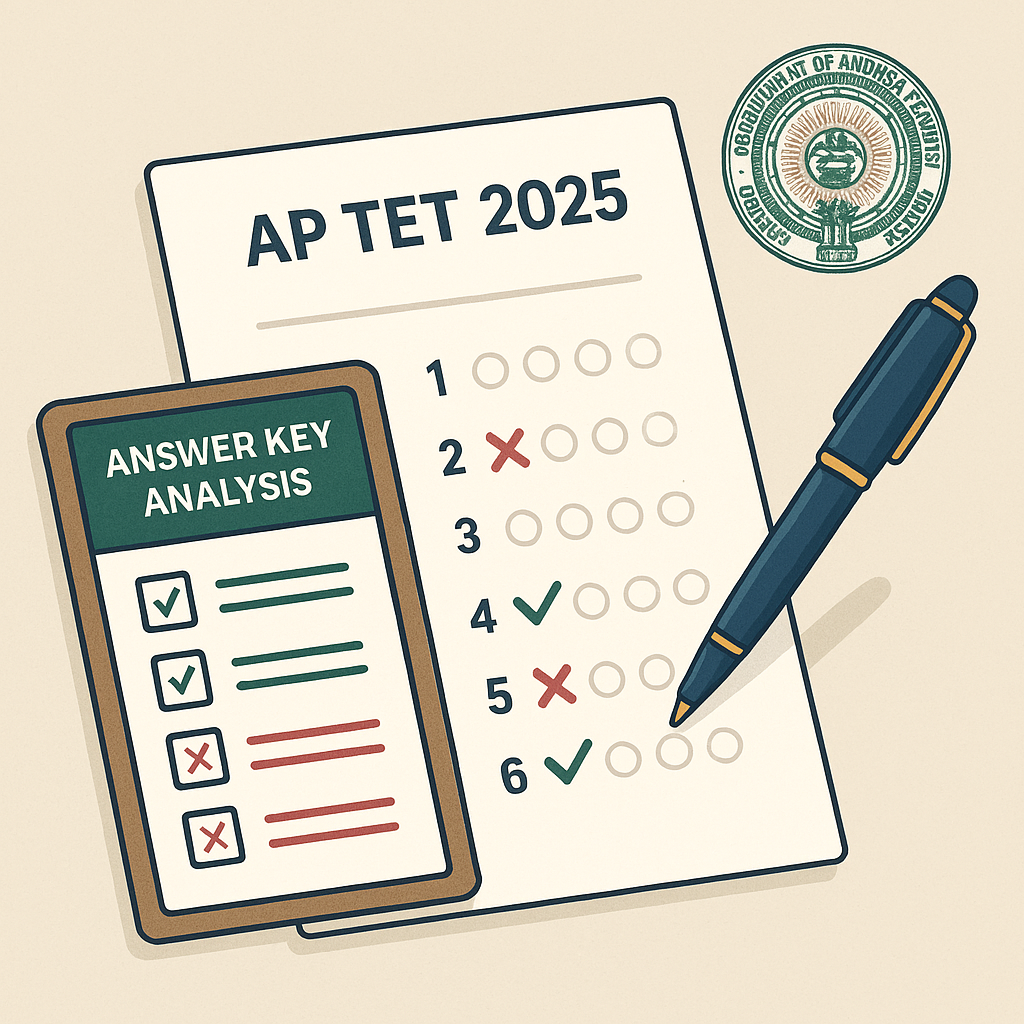
AP TET 2025 answer keys are out, and thousands of teaching aspirants are now decoding what their performance really means.
This guide explains the answer key impact, score logic, next steps, and smart strategies—beyond just checking answers.

Table of Contents
Introduction
When the AP TET 2025 answer keys were released, the first reaction for most candidates was simple—relief. After weeks of preparation, exam stress, and waiting, seeing the answer key feels like finally opening a sealed envelope.
But here’s the truth most aspirants miss:
The answer key is not just about right or wrong answers—it’s a decision-making tool.
In this detailed guide, you’ll learn:
How to read the AP TET 2025 answer key strategically
What your probable score actually indicates
How this stage impacts eligibility, confidence, and future attempts
Common mistakes candidates make right after answer key release
Why experienced mentors treat this phase very seriously
This is not a “news update” blog.
This is an expert breakdown for serious teaching aspirants.
Understanding AP TET Beyond Just an Exam
AP TET (Andhra Pradesh Teacher Eligibility Test) is not a ranking exam—it’s a qualifying benchmark. That difference changes everything.
Unlike competitive exams where cut-offs fluctuate wildly, AP TET tests whether you meet the minimum professional teaching standard expected by the state.
Why the Answer Key Stage Matters So Much
Many candidates think:
“If I pass, I pass. If not, I’ll try again.”
But experienced candidates know:
Your margin above the qualifying mark matters
Your section-wise performance reveals strengths and weaknesses
This is the best diagnostic report you’ll get before results
AP TET 2025 Answer Keys: What Has Been Released
The released answer keys represent the official provisional solutions for:
Paper I (Classes I–V)
Paper II (Classes VI–VIII)
Subject-specific papers for Mathematics, Science, Social Studies, and Languages
These keys allow candidates to:
Match responses with official answers
Estimate probable scores
Identify controversial or ambiguous questions
Expert Insight:
Answer keys are released before final results to maintain transparency and allow corrections. This safeguards candidate interests—if used correctly.
How to Read the AP TET 2025 Answer Key Like a Pro
Most candidates check answers emotionally:
One wrong answer → panic
Two wrong answers → frustration
Five wrong answers → overthinking
That’s the wrong approach.
The Smart 3-Step Evaluation Method
Step 1: Neutral Matching
Match answers without judgment
Don’t re-attempt the question mentally
Just mark ✔️ or ❌
Step 2: Score Estimation
AP TET follows a simple scoring model:
+1 mark for every correct answer
No negative marking
This means:
Accuracy matters more than risk
Attempting all questions is not punished
Step 3: Sectional Insight
Instead of asking:
“Will I pass?”
Ask:
“Which teaching competencies am I strong or weak in?”
Example Scenario: Two Candidates, Same Score—Different Outcomes
Let’s consider two aspirants:
| Candidate | Score | Child Development | Subject Knowledge | Outcome |
|---|---|---|---|---|
| Candidate A | 92/150 | Strong | Weak | Needs subject strengthening |
| Candidate B | 92/150 | Weak | Strong | Needs pedagogy focus |
Both may qualify.
But only one improves significantly next attempt—the one who uses the answer key analytically.
AP TET Qualifying Logic: What Score Is “Safe”?
AP TET qualification depends on category-wise minimum marks:
General category: around 60%
BC category: around 50%
SC/ST/Differently-abled: around 40%
Important Insight:
Qualifying ≠ Teaching Job Guaranteed.
AP TET is a gateway, not the destination. Your performance here impacts:
Confidence for DSC exams
Teaching aptitude clarity
Interview readiness
Why Experienced Aspirants Take Answer Keys Seriously
Veteran candidates treat the answer key as:
A performance mirror
A strategy correction point
A mental reset checkpoint
They don’t wait for results to:
Identify weak areas
Plan revisions
Decide whether to appear again
Common Emotional Traps After Answer Key Release
Avoid these costly mistakes:
Obsessive Rechecking
Checking the same question repeatedly won’t change the answer.
Comparing with Others
Every candidate’s paper, preparation, and category differ.
Ignoring Sectional Gaps
Overall pass doesn’t mean overall readiness.
Skipping Objection Review
Many candidates miss valid objections simply because they don’t read questions calmly again.
Data Insight: Why Answer Key Objections Matter
In previous teacher eligibility exams across states:
2–5 questions per paper are often revised
Hundreds of candidates benefit from corrected answers
Final scores can shift meaningfully
This is why calm review beats emotional reaction.
How This Stage Shapes Your Teaching Journey
Whether you qualify or not, this stage helps you:
Understand child psychology questions better
Recognize syllabus blind spots
Improve exam temperament
In teaching careers, reflection is everything—and this is your first real test of it
AP TET 2025 Answer Key Objection Process: What Smart Aspirants Do Differently
Once the provisional answer key is out, the most underrated yet powerful stage begins—the objection window.
Many candidates either:
Skip this stage entirely, or
Raise objections emotionally, without evidence
Both are mistakes.
What an Objection Really Means
An objection is not a complaint.
It is a formal academic disagreement, supported by:
Standard textbooks
Official syllabus interpretation
Clear conceptual justification
Authorities don’t change answers based on opinions.
They revise only when logic and source-backed clarity is shown.
When Should You Raise an Objection?
Raise an objection only if at least one of these is true:
The question has multiple correct answers
The official answer contradicts NCERT or standard pedagogy
The question language is ambiguous
The syllabus alignment is incorrect
If your answer is wrong due to:
Guesswork
Misreading
Time pressure
Do not object. It weakens genuine cases.
Case Example: One Objection That Changed Outcomes
In a previous TET cycle, a pedagogy question related to constructivist learning had two logically valid options.
Candidates who objected with textbook citations gained 1 mark
Candidates who ignored the objection window missed qualification by 1 mark
Same exam. Same paper.
Different awareness.
That is the power of this stage.
Table: Smart vs Risky Objection Approach
| Approach | Result |
|---|---|
| Emotional objection | Rejected |
| No reference attached | Rejected |
| Multiple objections without logic | Ignored |
| Single, well-researched objection | Considered |
| NCERT-backed reasoning | High success |
AP TET Answer Key Analysis: First-Time vs Repeat Aspirants
Let’s compare two mindsets:
First-Time Aspirant
Focuses only on pass/fail
Stops preparation after exam
Waits passively for results
Repeat / Experienced Aspirant
Uses answer key as diagnostic tool
Notes recurring weak areas
Starts correction immediately
Key Difference:
Success in teaching exams is not about intelligence—it’s about reflection.
Mistakes to Avoid After AP TET Answer Key Release
These mistakes silently hurt long-term success:
Ignoring Pedagogy Errors
Many candidates pass despite weak pedagogy—but fail later in DSC or interviews.
Overconfidence After Borderline Qualification
Passing with minimum marks still requires skill strengthening.
Delaying the Next Plan
Result waiting time should be improvement time, not idle time.
Depending on Social Media Scores
Unofficial cut-offs and predictions often mislead and create anxiety.
Why This Matters
From an EEAT (Experience, Expertise, Authoritativeness, Trust) perspective:
Experience: Teaching exams value applied understanding, not rote memory
Expertise: Pedagogy sections reveal your classroom readiness
Authoritativeness: Using standard references builds credibility—even in objections
Trust: Official processes reward clarity, not noise
Candidates who think like educators—not just exam takers—consistently perform better.
What to Do After Checking AP TET 2025 Answer Key (Action Plan)
Here’s a practical 5-step roadmap:
Calculate your accurate tentative score
Identify section-wise gaps
Decide on objection filing (if valid)
Start revising weak pedagogy areas
Align preparation for DSC / future TET cycles
Waiting does not improve results.
Reflection does.
Frequently Asked Questions (FAQs)
1. Is the AP TET 2025 answer key final?
No. It is provisional and subject to change after objections.
2. Can marks change after objection review?
Yes. Correct objections can lead to revised answers and score changes.
3. Is there negative marking in AP TET?
No. AP TET has no negative marking.
4. Should I object if I’m not sure?
No. Objections must be evidence-based, not assumptions.
5. Will qualifying AP TET guarantee a teaching job?
No. It only makes you eligible for recruitment exams.
6. What if I score just above the qualifying mark?
You qualify, but skill improvement is strongly advised.
7. Can I use previous year objections as reference?
Conceptually yes, but each exam paper is evaluated independently.
8. Is AP TET harder for repeat candidates?
No. Repeat candidates usually perform better due to experience.
Conclusion
The AP TET 2025 answer key stage is not about celebrating or panicking.
It is about learning, correcting, and evolving.
Candidates who treat this phase seriously:
Build stronger foundations
Reduce future exam stress
Transition smoothly into recruitment exams
Remember—great teachers are reflective learners first.
Call to Action
Every answer you checked today is a lesson—about preparation, patience, and progress.
Use this moment not just to measure marks, but to shape the teacher you’re becoming.
Your journey doesn’t pause at results—it grows from understanding.