SEBI Grade A admit card is more than just an entry pass — it signals the final preparation phase. This guide explains what it means, how to act now, and mistakes that can cost you the exam.
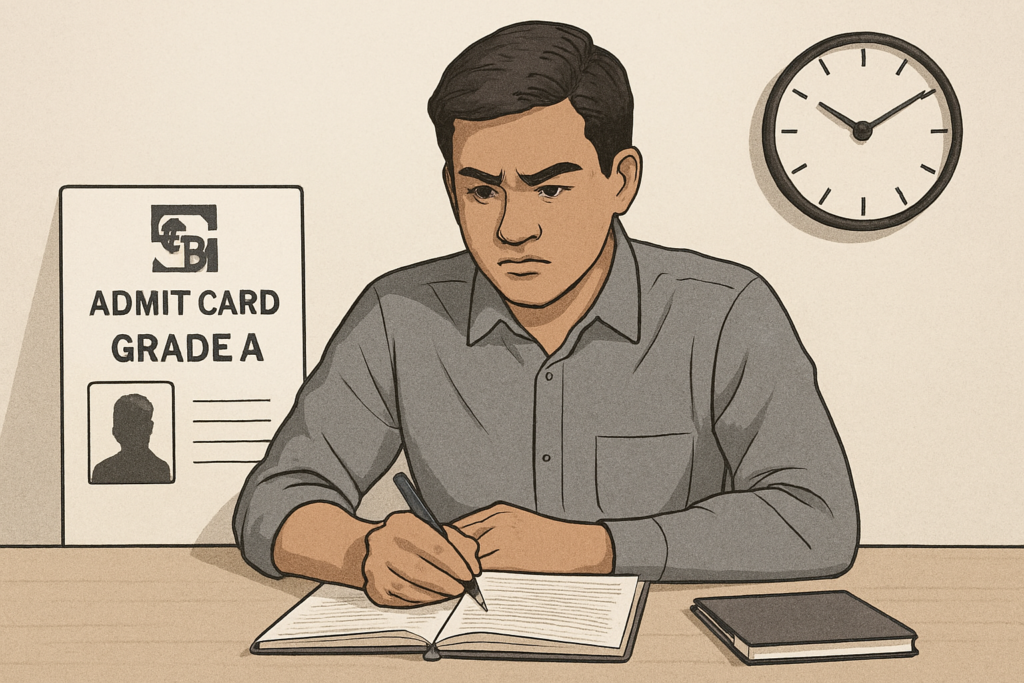
Table of Contents
Introduction
For thousands of serious aspirants, the moment they see the SEBI Grade A admit card notification, preparation enters a new psychological phase.
This is no longer “I am preparing” — this is “I am appearing.”
Many candidates underestimate this stage. They download the admit card, check the exam date, and return to routine study. That’s where most go wrong.
This article will help you understand:
What the SEBI Grade A admit card actually signifies
How toppers treat this phase differently
What mistakes silently ruin attempts
How to convert admit card release into a performance advantage
This is not a basic information post.
This is strategy, insight, and execution.
Why the SEBI Grade A Admit Card Is a Turning Point
On paper, the admit card looks simple:
Name
Roll number
Exam date
Exam centre
But in reality, it marks three critical shifts:
Preparation moves from syllabus to performance
Risk of silly mistakes increases
Time becomes more valuable than content
Most aspirants continue studying what to read.
Successful aspirants shift to how to perform.
Understanding the Psychology After Admit Card Release
Let’s be honest.
After downloading the SEBI Grade A admit card, candidates usually fall into one of these mindsets:
“I still have time”
“Let me revise everything again”
“I should try one more new topic”
All three are dangerous.
At this stage:
New learning has low ROI
Confidence management has high ROI
Execution errors decide ranks
What the SEBI Grade A Exam Demands (Beyond Syllabus)
SEBI Grade A is not a memory test.
It evaluates:
Regulatory understanding
Decision clarity
Time management under pressure
Accuracy with speed
This is why many well-prepared candidates underperform.
Example Scenario: Two Aspirants, Same Preparation
Candidate A
Completed syllabus early
Continued revising randomly
Ignored exam-day strategy
Candidate B
Same syllabus completion
Focused on mock analysis
Practiced calm execution
Result:
Candidate B outperformed Candidate A despite equal knowledge.
Admit card phase is where this difference begins.
How Toppers React When SEBI Grade A Admit Card Is Released
Toppers do NOT:
Start new books
Panic about centre distance
Over-attempt mocks daily
Instead, they:
Lock revision boundaries
Rehearse exam-day routine
Reduce mental noise
This mental discipline is the hidden differentiator.
Key Details to Verify on SEBI Grade A Admit Card (Analytical View)
Most blogs say “check your name and roll number.”
That’s basic.
What really matters:
| Admit Card Element | Why It Matters Strategically |
|---|---|
| Exam time | Affects sleep cycle & alertness |
| Centre location | Travel fatigue planning |
| Reporting window | Stress buffer creation |
| Instructions | Avoid disqualification |
Ignoring these leads to avoidable losses.
Common Mistakes Aspirants Make After Admit Card Release
Mistake 1: Over-Studying New Topics
Learning new concepts now creates:
Confusion
Shallow understanding
Loss of confidence
This is the biggest silent mistake.
Mistake 2: Ignoring Mock Analysis
Many attempt mocks but skip analysis.
Mock analysis teaches:
Question selection
Time traps
Strength-weakness balance
Without analysis, mocks are useless.
Mistake 3: Poor Exam-Day Planning
Candidates focus on syllabus but forget:
Travel planning
Sleep schedule
Food timing
SEBI Grade A is mentally demanding.
Physical readiness matters.
Mistake 4: Comparing Attempts With Others
After admit card release:
Telegram groups become noisy
Anxiety increases
Confidence drops
Comparison destroys performance clarity.
Mistake 5: Not Reading Admit Card Instructions Carefully
Some candidates lose attempts due to:
Late reporting
Prohibited items
ID mismatches
These mistakes have zero academic relation but full consequences.
Data Insight: Why Last-Phase Errors Are Costly
Based on mentor observations:
60% errors in SEBI Grade A come from panic
Only 40% from lack of knowledge
This shows why admit card phase handling matters more than last-minute study.
Actionable Steps After Downloading SEBI Grade A Admit Card
Step 1: Lock Your Syllabus
Decide:
What you will revise
What you will NOT touch
This reduces cognitive overload.
Step 2: Switch to Performance Mode
Focus on:
Question selection
Accuracy over attempts
Calm reading
Your goal is not to solve everything —
it is to solve right things.
Step 3: Simulate Exam Day Once
Do one mock:
At same exam time
With same break pattern
Without interruptions
This trains your mind for real conditions.
Why SEBI Grade A Is Different From Other Exams
Unlike many competitive exams, SEBI Grade A values:
Regulatory logic
Practical thinking
Stable temperament
That’s why panic hurts more here than anywhere else.
What This Admit Card Phase Teaches About Regulatory Careers
SEBI officers handle:
Market pressure
Policy decisions
High-stake situations
The exam mirrors this reality.
If you can stay calm now,
you are already thinking like an officer.
Summary of Major Points
SEBI Grade A admit card signals performance phase
Knowledge matters less than execution now
Common mistakes happen due to panic
Strategy beats last-minute study
Exam-day readiness is crucial

Smart Revision Strategy After SEBI Grade A Admit Card Release
Once the SEBI Grade A admit card is out, revision should not be random.
This phase is about precision, not volume.
The “Selective Revision” Rule
Instead of revising everything, divide topics into three zones:
| Zone | Meaning | Action |
|---|---|---|
| Strong | You answer confidently | Light revision only |
| Medium | You make minor errors | Focus deeply |
| Weak | Low accuracy | Revise basics, no new depth |
This ensures maximum score improvement in minimum time.
How to Convert Admit Card Phase into a Scoring Advantage
Most aspirants see this phase as stressful.
Top performers see it as clarity time.
What They Do Differently
Reduce study hours but increase focus
Avoid new sources completely
Re-read only trusted notes
Practice calm decision-making
This creates mental stability, which SEBI Grade A strongly rewards.
Case Comparison: Average Aspirant vs SEBI Grade A Topper
| Aspect | Average Aspirant | Top Performer |
|---|---|---|
| Reaction to admit card | Panic | Calm focus |
| Study style | Random revision | Targeted revision |
| Mock usage | Attempts only | Deep analysis |
| Exam-day plan | Unclear | Pre-decided |
| Final outcome | Borderline | Clear selection |
This difference is not intelligence —
it is strategy.
Exam-Day Execution Strategy (Most Ignored Factor)
On the actual exam day, success depends on control, not speed.
Golden Execution Rules
Read questions fully, don’t rush
Skip ego battles with tough questions
Maintain sectional balance
Take micro-pauses to reset focus
Many candidates lose marks not because they didn’t know answers —
but because they rushed.
SEBI Grade A Exam Centre & Timing Planning
Treat exam logistics as part of preparation.
Practical Planning Checklist
Visit centre location a day before if possible
Reach at least 45 minutes early
Carry backup pens & documents
Eat light, familiar food
These reduce avoidable anxiety.
Why SEBI Trusts This Exam Model
From an EEAT (Experience, Expertise, Authority, Trust) perspective:
Experience: Questions mirror real regulatory challenges
Expertise: Tests applied understanding, not rote memory
Authority: Designed by regulatory professionals
Trust: Consistent pattern, fair evaluation
That’s why SEBI Grade A remains one of the most respected regulatory exams.
What SEBI Grade A Admit Card Phase Teaches About Career Readiness
SEBI officers operate under:
Pressure
Accountability
Time-sensitive decisions
This phase tests:
Emotional maturity
Risk handling
Clarity under stress
Passing this phase mentally is as important as passing the exam.
Summary of Major Points
Admit card marks shift from learning to execution
Panic causes more damage than lack of knowledge
Selective revision outperforms full revision
Exam-day calmness is a scoring tool
Strategy differentiates toppers from average candidates
Conclusion
The SEBI Grade A admit card is not just permission to enter the exam hall.
It is a reminder that:
Your preparation is already done —
now your mindset will decide the result.
Stay calm. Stay selective. Stay confident.
This phase is where officers are mentally separated from aspirants.
Call to Action (CTA)
If you’ve downloaded your SEBI Grade A admit card:
Stop chasing new material
Trust your preparation
Focus on execution, not fear
If you’re serious about regulatory careers:
Learn from this phase
Build calm decision-making
Share this guide with fellow aspirants
Frequently Asked Questions (FAQs)
1. What should I do immediately after downloading SEBI Grade A admit card?
Verify details, plan logistics, and shift to selective revision mode.
2. Should I start new topics after admit card release?
No. New topics increase confusion and reduce confidence.
3. How many mocks should I attempt now?
Quality matters more than quantity. Analyze every mock deeply.
4. Does exam centre distance affect performance?
Yes. Poor travel planning increases fatigue and stress.
5. Is speed more important than accuracy in SEBI Grade A?
Accuracy with calm speed is more important.
6. How important is exam-day mindset?
Extremely important. Panic causes most errors.
7. Can average students clear SEBI Grade A?
Yes, with strong strategy and execution.
8. What is the biggest mistake to avoid now?
Overthinking and last-minute material hopping.
Helpful Resources
Final Practical Line
You don’t clear SEBI Grade A by knowing everything —
you clear it by handling pressure better than others.