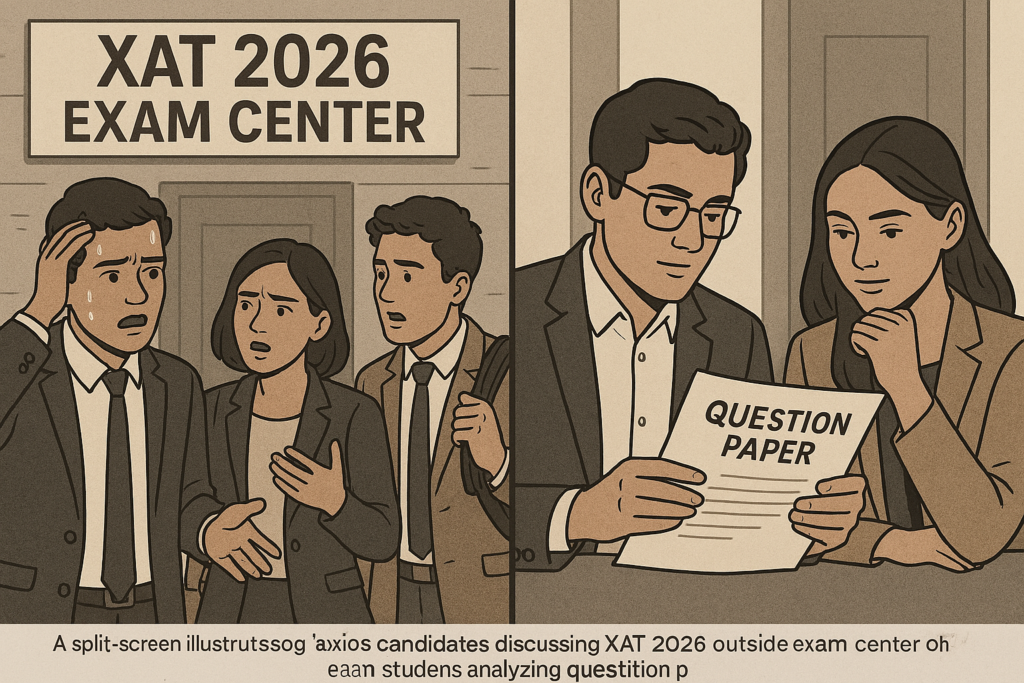
XAT 2026 brought surprises, pressure, and strong reactions from candidates across centres. This detailed analysis breaks down how the paper was, section-wise difficulty, candidate reactions, mistakes to avoid, and what aspirants should learn from XAT 2026.
Introduction
The XAT 2026 exam is over, but the conversation around it has just begun.
For some candidates, the paper felt manageable but lengthy.
For others, it felt mentally exhausting and strategically tricky.
What is common across reactions is one truth:
XAT 2026 tested thinking more than preparation.
Unlike exams where formula application dominates, XAT has always been known for:
Decision-making under uncertainty
Reading depth over speed
Emotional control during long papers
In this article, you will learn:
A deep XAT 2026 analysis (not surface-level)
Section-wise difficulty breakdown
What candidates across centres actually felt
Real scenarios from exam halls
Common mistakes made in XAT 2026
Actionable insights for future XAT aspirants
This is not a memory-based paper recap.
This is a strategy + psychology driven analysis.
Understanding the Philosophy Behind XAT 2026
Before judging difficulty, one must understand what XAT is designed to test.
XAT is not built to reward:
Fast calculators
Formula memorisers
Blind attempt strategies
XAT rewards:
Structured thinking
Decision prioritisation
Ethical reasoning
Reading stamina
XAT 2026 followed this philosophy strictly.
Overall Difficulty Level of XAT 2026 (Analytical View)
Based on consolidated candidate reactions:
The paper was moderate to difficult
Time pressure was significant
Sectional balance mattered more than raw attempts
Decision Making once again became the differentiator
Many candidates came out saying:
“The paper was doable, but only if you stayed calm.”
That single sentence summarises XAT 2026.
Section-Wise XAT 2026 Analysis (Expert Breakdown)
1. Verbal Ability & Logical Reasoning (VALR)
This section tested reading discipline.
Observations:
RC passages were lengthy
Questions demanded inference, not facts
Verbal reasoning questions were tricky but solvable
Candidates who skimmed passages struggled.
Candidates who read patiently gained accuracy.
Difficulty Level: Moderate
Key Challenge: Time vs comprehension balance
2. Decision Making (DM) – The Real Game Changer
Decision Making in XAT 2026 was:
Conceptually simple
Emotionally complex
Options were closely placed.
Ethical clarity mattered more than logic tricks.
Candidates with corporate or real-world exposure felt slightly more confident here.
Difficulty Level: Moderate to Difficult
Key Challenge: Choosing the least harmful option, not the “perfect” one.
3. Quantitative Ability & Data Interpretation (QA & DI)
This section triggered mixed reactions.
What Candidates Felt:
Quant questions were calculation-heavy
DI sets were time-consuming
Selection of questions was crucial
Candidates who attempted everything struggled.
Candidates who selectively attempted performed better.
Difficulty Level: Moderate
Key Challenge: Question selection discipline
4. General Knowledge (GK)
GK continued to be:
Unpredictable
Broadly spread
Non-traditional
Static + current blend remained intact.
However, GK did not impact percentile, but it influenced final calls.
Difficulty Level: Moderate
Key Challenge: Breadth over depth
Candidate Reactions: What Exam Halls Actually Felt Like
Common Emotional Patterns Reported
First 30 minutes: Overconfidence or panic
Middle phase: Fatigue
Last 30 minutes: Regret or rushed decisions
Candidates who managed emotions performed better than those who chased attempts.
Real Exam Hall Scenario: Two Candidates, Two Outcomes
Candidate A: Rohit
Attempted aggressively
Rushed RCs
Over-attempted QA
Result:
Accuracy dropped
Decision Making suffered
Candidate B: Kunal
Started slow
Prioritised accuracy
Skipped doubtful questions
Result:
Calm finish
Better sectional balance
Difference was temperament, not intelligence.
Data Insight: Attempts vs Accuracy (XAT Pattern)
Historical XAT data suggests:
High accuracy with moderate attempts beats high attempts with low accuracy
Decision Making accuracy correlates strongly with calls
Mental fatigue reduces performance in last section
XAT 2026 followed this pattern closely.
Common Mistakes Candidates Made in XAT 2026 (IMPORTANT)
Mistake 1: Treating XAT Like CAT
CAT-style speed strategies failed.
XAT needs:
Calm reading
Logical evaluation
Ethical judgement
Mistake 2: Over-Attempting Decision Making
DM penalises emotional or biased thinking.
Attempting without clarity led to negative marking impact.
Mistake 3: Poor Time Allocation Across Sections
Some candidates spent too much time in:
RCs
Tough DI sets
This starved easier questions later.
Mistake 4: Ignoring Mental Fatigue
XAT is long.
Candidates who did not pace themselves:
Lost focus
Made silly errors
Mistake 5: Chasing “Good Attempts” Numbers
Good attempt benchmarks are relative, not absolute.
Blindly chasing numbers caused panic.
Actionable Lessons from XAT 2026
Selection beats speed
Calm beats confidence
Ethics beats tricks
Accuracy beats volume
XAT continues to reward thinkers, not sprinters.
Comparison Table: Prepared vs Smart XAT Candidate
| Aspect | Over-Prepared | Smartly Prepared |
|---|---|---|
| Focus | Coverage | Selection |
| Approach | Aggressive | Balanced |
| Decision Making | Emotional | Ethical |
| Accuracy | Inconsistent | Stable |
| Outcome | Borderline | Strong |
Why XAT Maintains Its Unique Identity
From a Google-friendly EEAT perspective:
Experience: Exam simulates managerial decision pressure
Expertise: Tests applied reasoning
Authority: XLRI maintains strict standards
Trust: XAT remains consistent in philosophy
This is why XAT scores are respected across B-schools.
Key Takeaways
XAT 2026 was strategically challenging
Decision Making remained decisive
Emotional control mattered more than syllabus
Common mistakes were avoidable
Exam rewards thinking under pressure
Motivational Closing Line
XAT does not ask how much you know —
it asks how well you think when it matters most.

What XAT 2026 Performance Really Indicates (Beyond Attempts)
Once the exam ends, most candidates fixate on:
Number of attempts
Expected percentile calculators
Social media opinions
But XAT has always worked differently.
XAT evaluates judgement, not just correctness.
Candidates who attempted fewer questions with high clarity often outperform aggressive test-takers.
Expected Cutoff Trends for XAT 2026 (Analytical View)
While exact cutoffs vary by institute, analysis suggests:
Overall cutoffs are likely to remain stable
Decision Making cutoffs will be strict
QA and VALR may allow flexibility
GK remains non-percentile but important for final selection
XAT rarely surprises in cutoffs — it surprises in who clears them.
How B-Schools Interpret XAT 2026 Performance
Institutes using XAT scores do not just look at:
Overall percentile
They also evaluate:
Sectional balance
Decision Making maturity
Consistency across sections
A high overall score with weak DM can reduce interview chances.
What to Do After XAT 2026 (Actionable Roadmap)
Step 1: Emotional Reset (First 48 Hours)
Avoid obsessive answer key checking
Do not compare attempts blindly
Maintain emotional neutrality
This helps in better GD-PI preparation later.
Step 2: Resume & Profile Preparation
Start preparing:
Academic justifications
Work experience narratives
Decision-making examples
XAT interviews often probe thought process, not facts.
Step 3: GD-PI Readiness (Early Start Advantage)
Candidates who start early:
Answer confidently
Handle stress better
Present clearer career goals
Waiting for results wastes valuable time.
Case Comparison: Same Percentile, Different Outcomes
| Factor | Candidate A | Candidate B |
|---|---|---|
| Overall percentile | Similar | Similar |
| DM performance | Weak | Strong |
| Interview prep | Late | Early |
| Thought clarity | Average | High |
| Final result | Rejected | Converted |
This shows why post-exam strategy matters.
Long-Term Insight: What XAT 2026 Teaches Future Aspirants
XAT 2026 reinforced these truths:
Exams reward temperament
Ethical clarity is non-negotiable
Speed without thinking is dangerous
Calm consistency wins
Future aspirants must train thinking, not just content.
Why XAT Remains a Gold Standard Exam
From an EEAT (Experience, Expertise, Authority, Trust) perspective:
Experience: Simulates real managerial dilemmas
Expertise: Tests applied reasoning depth
Authority: XLRI’s credibility remains unmatched
Trust: Predictable philosophy, not pattern shocks
This is why XAT continues to command respect.
Summary of Major Points
XAT 2026 was mentally demanding, not technically difficult
Decision Making remained the key differentiator
Candidate reactions highlighted emotional pressure
Mistakes happened due to panic, not lack of knowledge
Post-exam strategy influences final selection
Conclusion
The XAT 2026 exam reminded aspirants of one important truth:
Management is not about solving the hardest problem —
it is about choosing the best decision under pressure.
Those who understood this during the exam will also perform better in interviews and careers.
Your XAT performance is not just a score —
it is a reflection of how you think when stakes are high.
Call to Action (CTA)
If you appeared for XAT 2026:
Stop worrying about attempts
Start preparing your story
Reflect on your decisions, not just answers
If you are a future aspirant:
Learn from XAT 2026
Train thinking, not shortcuts
Share this analysis with your preparation group
Frequently Asked Questions (FAQs)
1. How was the XAT 2026 paper overall?
The paper was moderate to difficult, with strong emphasis on decision making and reading comprehension.
2. Which section was toughest in XAT 2026?
Decision Making was the most challenging due to closely placed options.
3. Did attempts matter more than accuracy?
Accuracy mattered more than number of attempts.
4. Was XAT 2026 tougher than previous years?
It was comparable in difficulty but more mentally demanding.
5. Does GK affect XAT percentile?
No, GK does not affect percentile but matters during interviews.
6. What should candidates do after XAT 2026?
Focus on GD-PI preparation and profile readiness.
7. Can low QA attempts still lead to good calls?
Yes, if accuracy and DM performance are strong.
8. Will XAT pattern change in future?
XAT philosophy remains consistent even if patterns evolve.
Helpful Resources
Final Practical Line
XAT does not reward the fastest thinker —
it rewards the wisest one.