ICSI has released the CSEET Admit Card, officially setting the stage for the upcoming exam. This in-depth guide explains the exam date, admit card significance, strategic preparation insights, common mistakes, and what aspirants should do next.
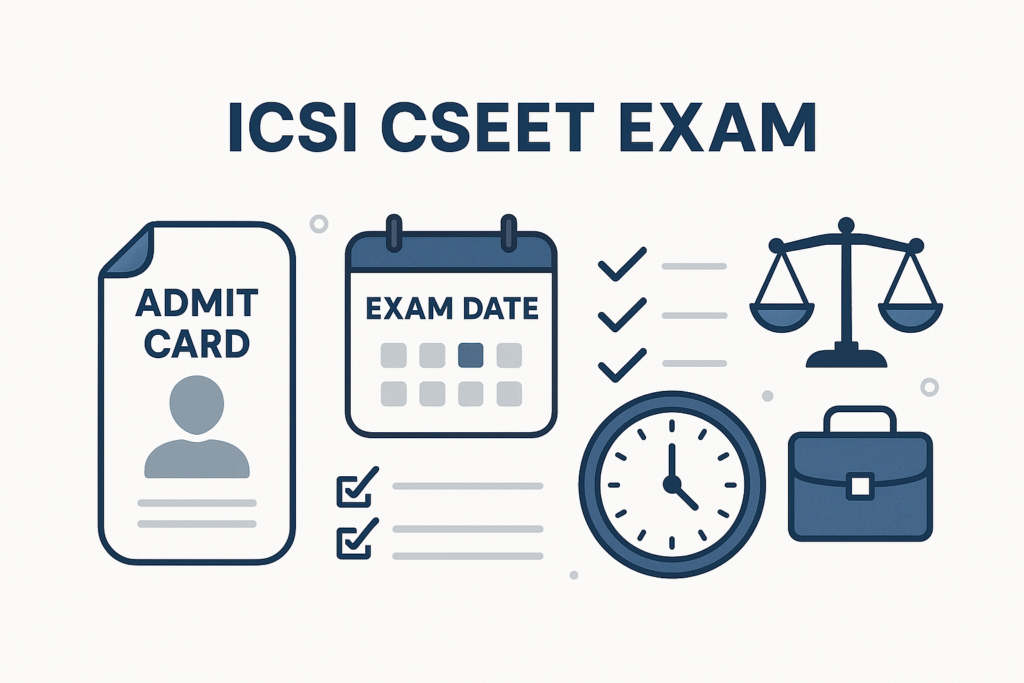
Table of Contents
Introduction
The moment the ICSI CSEET admit card is released, the preparation journey enters its most decisive phase.
Until now, aspirants were studying with flexible timelines.
Now, the exam date is fixed — and uncertainty is gone.
For many candidates, this admit card is more than a document.
It is a psychological shift from preparation mode to performance mode.
In this article, you will learn:
What the ICSI CSEET admit card release actually signals
How the confirmed exam date should reshape your study strategy
What serious candidates do differently after admit card release
Common mistakes to avoid in this critical phase
Practical, actionable steps to maximize your score
This is not a basic “how to download admit card” article.
This is a strategy-driven guide for CSEET success.
Understanding the Importance of CSEET Admit Card Release
Many candidates underestimate the importance of this phase.
But experienced mentors know:
Admit card release is the real countdown, not the syllabus announcement.
What the Admit Card Confirms
The CSEET admit card confirms:
Your exam eligibility
Your exact exam date and shift
Mode of examination
Candidate responsibility for compliance
Once released, there is no ambiguity left.
Why ICSI Releases Admit Cards at This Stage (Expert Analysis)
From ICSI’s perspective, admit card release serves three purposes:
1. Candidate Accountability
Once admit cards are out:
Excuses reduce
Absenteeism drops
Exam seriousness increases
2. Technical Readiness Confirmation
Since CSEET is conducted in computer-based / remote proctored mode, admit cards act as a final verification checkpoint.
3. Mental Transition Trigger
This phase pushes candidates from:
“I still have time”
to
“The exam is real and near”
This mental transition directly affects performance.
CSEET Exam Date: Why It Is More Important Than You Think
The confirmed CSEET exam date is not just a calendar entry.
It determines:
Your revision cycles
Mock test frequency
Sleep schedule
Stress management strategy
Candidates who align preparation with the exam date outperform those who continue random studying.
Strategic Shift Required After Admit Card Release
Once the admit card is available, preparation must change.
Before Admit Card
Syllabus completion focus
Topic accumulation
Resource exploration
After Admit Card
Precision revision
Weak-area correction
Execution practice
This shift is where many aspirants fail.
Real-Life Scenario: Two CSEET Aspirants
Candidate A: Neha
Admit card released
Continued watching long lectures
Delayed revision
Result:
Poor recall
Panic during exam
Missed cutoff narrowly
Candidate B: Aman
Admit card released
Switched to short notes
Practiced MCQs daily
Result:
Calm exam experience
Better time management
Comfortable qualification
Difference was strategy, not intelligence.
Data Insight: Why Final-Phase Strategy Matters
Based on CSEET attempt trends:
Over 60% mistakes occur in known topics
Accuracy drops due to poor revision
Time pressure causes avoidable errors
This shows:
Final-phase discipline matters more than last-minute learning.
Common Mistakes Aspirants Make After CSEET Admit Card Release
Mistake 1: Starting New Topics After Admit Card
Many aspirants panic and start untouched topics.
Problem:
Incomplete understanding
Poor retention
Increased confusion
Fix: Strengthen known topics first.
Mistake 2: Ignoring Mock Tests
Some candidates believe theory is enough.
Reality:
CSEET tests application
Time pressure matters
Fix: Attempt at least 1 mock every 2 days.
Mistake 3: Overchecking Admit Card Details Repeatedly
Constantly worrying about:
Exam time
Login process
Technical issues
This drains mental energy.
Fix: Verify once, prepare calmly.
Mistake 4: Neglecting Mental Health
Late nights, anxiety, and comparison worsen performance.
Fix: Maintain sleep routine and emotional balance.
Mistake 5: Treating Admit Card as Just a Formality
This mindset delays serious preparation.
Fix: Treat admit card release as final warning bell.
Actionable 14-Day Plan After Admit Card Release
Days 1–4
Revise core concepts
Identify weak areas
Days 5–9
MCQ practice
Mock tests
Error analysis
Days 10–12
Light revision
Formula recall
Concept clarity
Days 13–14
Mental calm
Sleep regulation
Confidence building
Comparison Table: Casual vs Serious Aspirant
| Aspect | Casual Aspirant | Serious Aspirant |
|---|---|---|
| Admit card reaction | Neutral | Strategic |
| Study style | Random | Focused |
| Mock usage | Rare | Regular |
| Stress control | Poor | Balanced |
| Outcome | Uncertain | Predictable |
Why ICSI’s Process Builds Trust
From a Google-friendly EEAT perspective:
Experience: Exam pattern filters readiness
Expertise: CSEET tests applied knowledge
Authority: ICSI maintains strict standards
Trust: Structured process ensures fairness
This is why CSEET remains a strong foundation for CS aspirants.
Key Learnings
CSEET admit card release is a strategic milestone
Exam date confirmation reshapes preparation
Most errors happen after admit card release
Common mistakes are avoidable with discipline
Final-phase planning decides qualification
Motivational Closing Line
When the admit card arrives, preparation must mature —
because the exam no longer waits.

Exam-Day Strategy After CSEET Admit Card Release
Once the ICSI CSEET admit card is in hand, success depends less on how much you know and more on how well you execute on exam day.
CSEET is designed to test:
Concept clarity
Decision-making under time pressure
Professional aptitude
Candidates who treat the exam like a mock test often lose marks they actually deserve.
Understanding the Structure of the CSEET Exam (Strategic View)
CSEET is not about solving difficult problems.
It is about avoiding simple mistakes consistently.
What the Exam Really Tests
Logical thinking
Business awareness
Legal comprehension
Communication sense
Candidates who attempt emotionally tend to misread questions.
Section-Wise Scoring Approach (Practical)
1. Business Communication
Focus on comprehension, not memorization
Read questions fully before answering
Avoid over-interpreting simple sentences
2. Legal Aptitude & Logical Reasoning
Logic questions reward calm thinking
Law questions punish half-knowledge
Skip doubtful questions initially
3. Economic & Business Environment
Current-oriented concepts matter
Static facts are less valuable than understanding
4. Current Affairs & Presentation Skills
Awareness over details
Clarity of thought matters more than facts
Time Management: The Silent Rank Booster
Time is rarely the problem.
Decision-making is.
Smart Time Use Strategy
First round: Sure questions only
Second round: Medium confidence questions
Final round: Review marked questions
Candidates who follow this structure show higher accuracy.
Exam-Day Checklist (Do This, Not That)
Before the Exam
Check system readiness
Arrange ID and documents
Stay offline mentally
During the Exam
Read carefully
Trust first instincts
Avoid ego attempts
After the Exam
Do not over-analyze
Maintain emotional neutrality
Case Example: Calm Executor vs Over-Thinker
| Factor | Over-Thinker | Calm Executor |
|---|---|---|
| Question reading | Rushed | Patient |
| Decision making | Emotional | Logical |
| Time usage | Uneven | Balanced |
| Stress handling | Poor | Controlled |
| Final result | Borderline | Comfortable |
What to Expect After the CSEET Exam
After completing the exam, candidates often:
Replay questions mentally
Compare attempts with peers
Worry about cutoff speculation
This behavior adds stress without benefit.
Productive candidates shift focus forward.
Career Path After Clearing CSEET
Clearing CSEET is a gateway, not the destination.
It allows entry into:
CS Executive Programme
Structured corporate law learning
Professional skill development
The journey becomes demanding but rewarding.
Why CSEET Builds Professional Credibility
From an EEAT (Experience, Expertise, Authority, Trust) perspective:
Experience: Exam simulates professional pressure
Expertise: Tests real-world applicability
Authority: ICSI sets national standards
Trust: Qualification signals commitment to the profession
This is why CSEET remains a respected entry filter.
Key Takeaways
Admit card release marks the final preparation phase
Exam date alignment improves performance
Execution matters more than content volume
Calm strategy outperforms panic preparation
Professional mindset begins at CSEET level
Conclusion
The ICSI CSEET admit card release is not a routine update —
it is a call to discipline.
Candidates who:
Adjust preparation strategy
Respect the exam structure
Maintain emotional control
consistently succeed.
Remember, the CSEET exam does not demand perfection —
it demands clarity, calmness, and confidence.
Call to Action (CTA)
If your CSEET exam date is approaching:
Stop chasing new content
Focus on execution and accuracy
Share this guide with a fellow aspirant who is feeling anxious
Preparation opens doors.
Execution decides who walks through them.
Frequently Asked Questions (FAQs)
1. What does CSEET admit card release mean?
It confirms exam eligibility, date, and readiness for the upcoming test.
2. Is admit card mandatory for CSEET exam?
Yes, candidates must have the admit card to appear for the exam.
3. Can exam date change after admit card release?
Generally no, the date mentioned is final.
4. What should I do after downloading admit card?
Verify details once and shift focus to revision and mocks.
5. Is CSEET difficult to clear?
With proper strategy and calm execution, it is manageable.
6. Does admit card release affect preparation strategy?
Yes, it signals the shift from learning to execution mode.
7. What is the biggest mistake on exam day?
Over-thinking known questions and mismanaging time.
8. What comes after clearing CSEET?
Enrollment into CS Executive Programme and advanced studies.
Helpful Resources
Final Practical Line
A professional career begins the day you learn to perform under pressure —
not the day you clear the exam.