This detailed guide explains what NTA UGC NET truly tests, how candidates should interpret official updates, why many capable aspirants fail despite hard work, and how to prepare with clarity instead of confusion. You’ll also understand common mistakes candidates make, backed by real scenarios and expert insights.
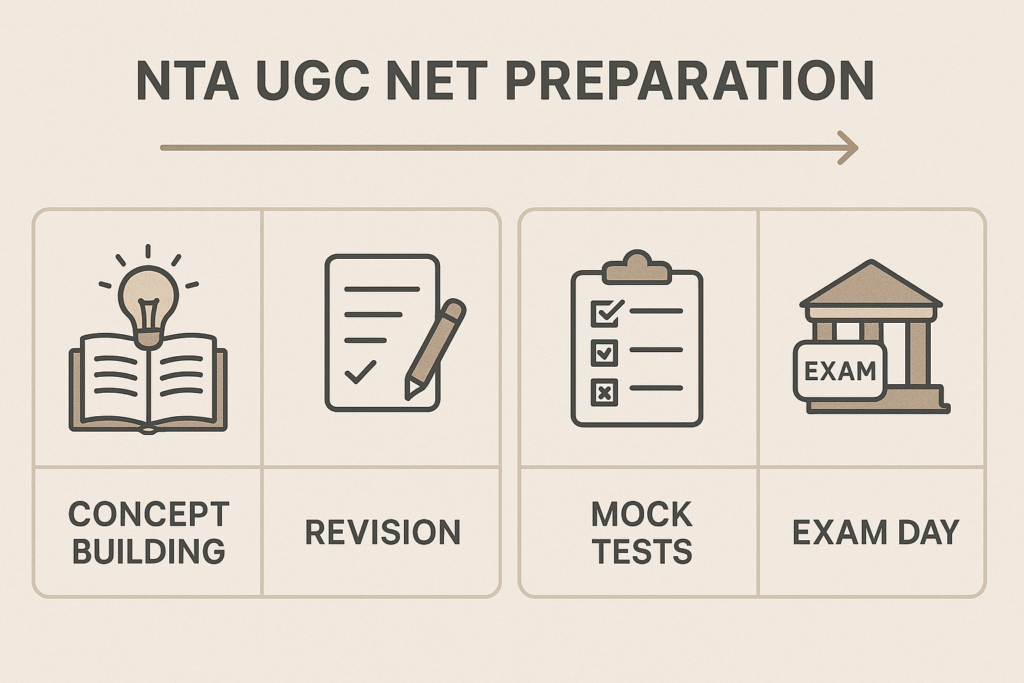
Table of Contents
Introduction: Why NTA UGC NET Is More Than Just Another Exam
Every year, lakhs of aspirants fill out the NTA UGC NET form with a single dream—to qualify for Assistant Professor or secure JRF. Yet, only a small fraction succeed.
Not because the syllabus is impossible.
Not because the competition is unfair.
But because most candidates misunderstand what NTA UGC NET actually evaluates.
This exam doesn’t reward rote learners. It rewards:
Conceptual clarity
Academic maturity
Strategic thinking
In this part, we’ll break down the exam’s deeper expectations—beyond notifications and dates.
Understanding the Purpose of NTA UGC NET (Most Aspirants Ignore This)
At its core, NTA UGC NET is not a recruitment exam. It is a quality benchmark.
The exam evaluates whether a candidate is:
Fit to teach at the undergraduate and postgraduate level
Capable of research-oriented thinking (especially for JRF)
Academically disciplined and methodical
This distinction matters because preparation strategy changes completely once you understand the intent behind the exam.
Paper 1 vs Paper 2: The Real Difference (Beyond Syllabus)
Most aspirants treat:
Paper 1 as “easy and scoring”
Paper 2 as “the real exam”
This mindset alone causes thousands of failures.
Paper 1 Tests
Teaching aptitude
Research orientation
Logical structure of thinking
Academic awareness
Paper 2 Tests
Depth of subject mastery
Conceptual interlinking
Application-based understanding
Insight:
Paper 1 often becomes the elimination round, while Paper 2 becomes the rank-decider.
Why Smart Candidates Still Fail NTA UGC NET
Let’s look at a real pattern seen across multiple cycles.
A Common Scenario
A postgraduate student:
Scores well in university exams
Has subject knowledge
Studies regularly
Yet fails UGC NET twice.
Why?
Because UGC NET questions are framed differently:
Less about memory
More about interpretation
Heavy focus on academic logic
This mismatch between effort and approach is the real problem.
Data Insight: Where Most Candidates Lose Marks
Based on analysis of past attempts and mock data trends:
| Area | Average Loss |
|---|---|
| Paper 1 – Research Aptitude | High |
| Paper 1 – Teaching Methods | Moderate |
| Paper 2 – Conceptual Questions | Very High |
| Paper 2 – Assertion/Reason | Critical |
This shows that strategy gaps, not lack of effort, cause failure.
How NTA’s Role Changes the Exam Nature
Earlier, NET exams were conducted by universities. Now, NTA (National Testing Agency) controls:
Question design
Normalization
Exam pattern consistency
What This Means for Aspirants
Higher standardization
Less predictability
More analytical questions
NTA emphasizes fairness through difficulty balance, not simplicity.
Actionable Preparation Framework (Start Applying Today)
Instead of studying everything at once, split preparation into three layers:
Layer 1: Concept Foundation
Understand theories, not just definitions
Study from standard academic sources
Build notes in your own words
Layer 2: Application Practice
Solve conceptual MCQs
Focus on “why” an option is correct
Practice elimination logic
Layer 3: Academic Maturity
Link topics across units
Understand evolution of theories
Think like a teacher, not a student
This layered approach aligns perfectly with NTA UGC NET’s evaluation style.
Common Mistakes Candidates Must Avoid (CRITICAL SECTION)
Mistake 1: Treating Paper 1 Casually
Many candidates think Paper 1 can be handled in the last month.
Reality: Paper 1 can destroy your cutoff chances.
Mistake 2: Over-Reliance on Coaching Notes
Notes are summaries—not substitutes for understanding.
UGC NET questions often go beyond coaching material phrasing.
Mistake 3: Ignoring PYQ Analysis
Solving previous questions without analysis is useless.
You must identify:
Repeated concepts
Question framing logic
Difficulty shifts
Mistake 4: Chasing Too Many Sources
More books ≠ better preparation.
Depth beats breadth in UGC NET.
Mistake 5: Studying Like a University Exam
UGC NET doesn’t reward long answers in your head.
It rewards clear, fast, and logical decisions.
Case Example: Two Aspirants, Two Outcomes
| Aspect | Aspirant A | Aspirant B |
|---|---|---|
| Sources | Limited & standard | Multiple random |
| PYQ Analysis | Deep | Minimal |
| Paper 1 Focus | Consistent | Ignored |
| Result | Qualified | Missed cutoff |
This comparison repeats every cycle—without exception.
Why This Exam Demands Authority Thinking
Google’s EEAT principles—Experience, Expertise, Authoritativeness, Trust—mirror exactly what UGC NET tests.
The exam expects:
Academic confidence
Logical consistency
Subject authority
This is why superficial preparation fails.

Advanced Preparation Strategy That Separates Qualifiers from the Crowd
Once the fundamentals are clear, success in NTA UGC NET depends on how intelligently you convert preparation into performance. This part focuses on execution strategy, time management, academic positioning, and long-term planning—the exact areas where most aspirants lose direction.
How Top Candidates Structure Their UGC NET Preparation
Unlike beginners, serious aspirants don’t study randomly. They follow a system-based approach.
The 4-Phase Preparation Model
Foundation Phase – Build concepts slowly but solidly
Integration Phase – Connect topics across units
Evaluation Phase – Mocks, PYQs, error analysis
Refinement Phase – Revision + speed optimization
Each phase has a clear purpose. Skipping any one weakens the final outcome.
Time Management That Works in Real Life (Not Timetable Fantasy)
Many aspirants create perfect timetables—and never follow them.
A Practical Weekly Model
Weekdays:
2–3 hours core subject
1 hour Paper 1
Weekends:
PYQ analysis
Mock test + review
This model works even for working professionals and research scholars.
Paper 1 Mastery: Turning a Neutral Paper into a Strength
Paper 1 is where rank gaps are created quietly.
Smart Approach
Focus on reasoning, research, and teaching aptitude
Practice conceptual MCQs instead of memorizing facts
Revise formulas, frameworks, and diagrams weekly
Paper 1 preparation should feel light but continuous.
Paper 2 Strategy: Depth Over Coverage
UGC NET Paper 2 doesn’t expect you to know everything. It expects you to:
Understand core theories
Identify incorrect statements quickly
Apply concepts to new contexts
Expert Insight
Most questions are designed so that:
Two options are obviously wrong
One is partially correct
One is conceptually precise
Your job is to identify precision, not familiarity.
Mock Tests: Why Analysis Matters More Than Scores
Taking mocks without analysis is like checking weight without changing diet.
Effective Mock Analysis Includes
Why you got a question wrong
Whether the mistake was conceptual or careless
What triggered confusion
A candidate who analyzes 10 mocks deeply often outperforms one who attempts 30 superficially.
Case Study: Average Student to UGC NET Qualifier
A postgraduate student failed UGC NET twice despite regular study.
What Changed in the Third Attempt
Reduced sources
Focused on PYQ trends
Started weekly answer reasoning
Gave equal importance to Paper 1
Result: Qualified with margin above cutoff.
This pattern is extremely common.
Using UGC NET as a Career Lever (Beyond Qualification)
UGC NET is not the end—it’s leverage.
Qualified candidates gain:
Eligibility for Assistant Professor roles
Access to PhD programs
Academic credibility
Treat preparation as professional development, not just exam prep.
Frequently Asked Questions (FAQs)
1. How many hours per day are enough for UGC NET?
3–5 focused hours daily are sufficient with the right strategy.
2. Is Paper 1 compulsory for JRF also?
Yes. Paper 1 marks affect both NET and JRF qualification.
3. Can I prepare UGC NET without coaching?
Yes, with standard books, PYQs, and disciplined planning.
4. How important are previous year questions?
Extremely important. They reveal NTA’s question logic.
5. Does normalization affect final results heavily?
It ensures fairness; strong conceptual preparation remains key.
6. Should I attempt all questions in the exam?
Only if you’re confident. Accuracy matters more than attempts.
7. How early should I start mock tests?
After completing 60–70% syllabus.
8. Is UGC NET harder than university exams?
Yes, because it tests application, not reproduction.
Conclusion
The NTA UGC NET exam rewards clarity, discipline, and academic maturity. It is not designed to trick candidates—but it filters out superficial preparation.
Those who:
Understand the exam’s intent
Prepare with structure
Revise intelligently
…consistently find their names on the qualified list.
Call to Action (CTA)
If you’re serious about qualifying NTA UGC NET, stop measuring effort in hours and start measuring it in clarity and outcomes.
Start today. Simplify your sources. Practice deliberately.
Success here doesn’t come from pressure—it comes from precision.