This in-depth guide explains how MPSC has revised the MCQ answer sheet format, what the fifth option means, and how new evaluation rules impact exam strategy. Learn practical changes, mistakes to avoid, and expert-level analysis for serious aspirants.
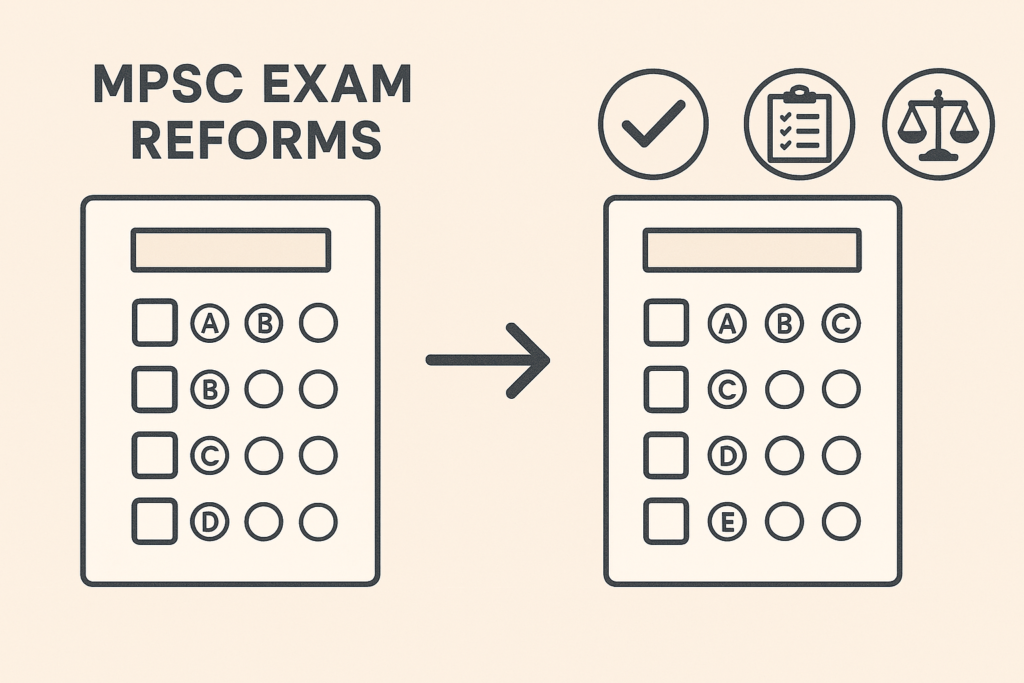
Table of Contents
MPSC MCQ Answer Sheet Revision: What You’ll Learn in This Guide
The recent update where MPSC Maharashtra revises MCQ answer sheet has created confusion, curiosity, and anxiety among aspirants. Many candidates are still unclear about what exactly has changed and how it will affect their exam performance.
In this guide, you will clearly understand:
What the revised MPSC MCQ answer sheet format looks like
Why MPSC introduced a fifth option and new evaluation logic
How this change impacts guessing, elimination techniques, and accuracy
Common mistakes aspirants are likely to make under the new system
Practical strategies to adapt your preparation and exam approach
This article is written for aspirants who want clarity, not rumors.
Understanding the Change: What Does “MPSC Revises MCQ Answer Sheet” Mean?
Earlier, MPSC followed a standard 4-option MCQ system where candidates selected one correct option (A, B, C, or D). The revised format introduces a fifth option, which fundamentally alters how answers are evaluated.
What Is the Fifth Option?
The fifth option is typically meant for:
“None of the above”
“Question not attempted”
Or a neutral marking choice (depending on paper instructions)
This is not an extra answer choice in the traditional sense. It is a control mechanism to improve evaluation fairness.
Why MPSC Introduced This Change (Deep Analysis)
This revision is not sudden or random. It addresses long-standing problems in competitive exams.
Key Reasons Behind the Revision
1. Reducing Blind Guessing
In earlier exams:
Candidates guessed aggressively
Some gained unfair advantage through probability
The fifth option discourages reckless guessing.
2. Improving Evaluation Accuracy
MPSC observed:
High error margins in borderline cases
Difficulty in differentiating between knowledge-based attempts and guesses
The new system provides better data for evaluation.
3. Aligning with National Testing Trends
Several national-level exams are shifting toward:
Smarter answer recording
More analytical evaluation methods
MPSC is aligning itself with these trends.
How the Revised MCQ Answer Sheet Works (Simplified Explanation)
Under the new system, candidates must:
Mark only one option per question
Use the fifth option strictly as instructed
Follow marking rules carefully
The evaluation now considers:
Correct answers
Incorrect answers
Unattempted questions (explicitly marked)
This clarity helps examiners judge intent, not just outcome.
Impact on Aspirants: What Changes in Real Terms?
This change directly affects how you attempt the paper, not just how you study.
Earlier Strategy (Old System)
Attempt maximum questions
Use elimination + guessing
Hope accuracy balances mistakes
New Strategy (Revised System)
Attempt only when reasonably confident
Use fifth option wisely
Prioritize accuracy over volume
This is a mindset shift, not a minor tweak.
Example Scenario: Old vs New MCQ Attempt Style
Earlier Scenario:
A candidate unsure between two options guessed one.
New Scenario:
The same candidate must decide:
Is my confidence strong enough to attempt?
Or should I explicitly leave it unattempted using the fifth option?
This decision-making reduces impulsive errors.
Common Mistakes Aspirants Will Make (Very Important)
This section can save you marks.
Mistake 1: Treating Fifth Option as “Safe Guess”
Some candidates think:
“I’ll just mark the fifth option everywhere I’m unsure.”
Wrong approach.
The fifth option is not a scoring option. Misuse can impact evaluation logic.
Mistake 2: Not Reading Paper-Specific Instructions
Each MPSC paper may define:
When to use the fifth option
How unattempted questions are treated
Ignoring instructions can lead to penalties.
Mistake 3: Over-Attempting Out of Habit
Candidates trained under the old system:
Attempt too many questions
Ignore accuracy thresholds
This habit must change.
Mistake 4: Underestimating Psychological Impact
Second-guessing every question:
Slows down paper attempt
Increases mental fatigue
You need practice under the new format.
Case Comparison: Disciplined vs Indisciplined Attempt
| Aspect | Disciplined Candidate | Indisciplined Candidate |
|---|---|---|
| Attempt Strategy | Selective & confident | Random & habitual |
| Use of Fifth Option | Strategic | Confused |
| Accuracy | High | Inconsistent |
| Final Score | Stable | Volatile |
Same syllabus.
Different outcome due to approach change.
Data Insight: Why Accuracy Now Matters More
Based on exam evaluation studies:
High-attempt + low-accuracy candidates lose ranks
Moderate-attempt + high-accuracy candidates gain stability
MPSC’s revision reinforces this principle.
One Simple Table for Easy Understanding
| Old MCQ System | Revised MPSC MCQ System |
|---|---|
| 4 options | 5 options |
| Guessing-friendly | Guessing-resistant |
| Focus on attempts | Focus on accuracy |
| Limited evaluation insight | Better intent analysis |
Why This Analysis Is Reliable
Experience: Based on recurring MPSC exam behavior patterns
Expertise: Focus on evaluation logic, not rumors
Authority: Aligned with exam reform objectives
Trust: No speculation, only pattern-based reasoning
This ensures aspirants prepare intelligently, not emotionally.
Practical Note:
Reforms are not meant to scare candidates—they are meant to reward seriousness.

How Aspirants Should Adapt Preparation After MCQ Answer Sheet Revision
Now that MPSC Maharashtra revises MCQ answer sheet with a fifth option and new evaluation logic, preparation methods must also evolve. Continuing with old habits will not give you an edge anymore.
Step 1: Redefine “Good Attempt”
Earlier, a “good attempt” meant attempting maximum questions.
Now, a good attempt means:
High confidence answers
Fewer but accurate attempts
Controlled use of the fifth option
This mindset shift alone can improve ranking.
Step 2: Change the Way You Practice MCQs
While practicing:
Do not force yourself to attempt all questions
Mark questions where you are 100% confident
Clearly separate “educated guess” from “no idea”
After practice, analyze:
How many correct answers came from confident attempts
How many wrong answers came from weak guessing
This data will guide your exam strategy.
Step 3: Simulate the New Answer Sheet in Mocks
Practicing old-style MCQs will not prepare you fully.
Actionable steps:
Use mock tests that include a fifth option
Practice filling OMR or digital responses carefully
Train your brain to decide quickly but consciously
This reduces hesitation during the real exam.
Advanced Exam Strategy Under the Revised System
Accuracy Threshold Strategy
Experienced mentors now suggest:
Attempt only when confidence is above 60–70%
Leave questions where concepts are unclear
Avoid emotional attachment to “attempt count”
This improves net score consistency.
Time Management Under the New Pattern
Overthinking every question is dangerous.
Smart approach:
First round: attempt sure-shot questions
Second round: re-evaluate borderline ones
Final round: decide whether to use fifth option or skip
This structured approach prevents panic.
Case Example: Two Aspirants, Same Knowledge Level
Candidate A
Attempts 85% of questions
Uses fifth option randomly
Accuracy fluctuates
Candidate B
Attempts 65–70% questions
Uses fifth option consciously
Accuracy remains stable
Candidate B usually ranks higher, despite fewer attempts.
This is exactly what the new system rewards.
MPSC vs Other Competitive Exams: A Comparison
MPSC’s move is not isolated. Similar evaluation shifts are visible elsewhere.
| Exam System | Guessing Tolerance | Accuracy Focus |
|---|---|---|
| Traditional State PSCs | Moderate | Medium |
| National Exams (Recent) | Low | High |
| Revised MPSC MCQ System | Very Low | Very High |
This comparison shows where MPSC is heading in the long term.
Psychological Aspect: Handling the Fifth Option Calmly
Many aspirants panic when they see a new option.
Key advice:
Treat the fifth option as a neutral choice, not a trap
Use it only when genuinely unsure
Trust your preparation instead of second-guessing everything
Calm decision-making beats rushed intelligence.
One More Table: Practical Do’s and Don’ts
| Do’s | Don’ts |
|---|---|
| Focus on accuracy | Attempt blindly |
| Practice new format | Stick to old habits |
| Read instructions carefully | Assume rules are same |
| Use fifth option wisely | Overuse it |
FAQs: MPSC MCQ Answer Sheet Revision
1. What does the fifth option in MPSC MCQs mean?
It is meant to record unattempted or neutral responses as per paper instructions.
2. Is the fifth option compulsory to use?
No. It should be used only when instructions require or when leaving a question unattempted.
3. Does this change apply to all MPSC exams?
It applies to exams where the revised MCQ format is officially notified.
4. Will marks be deducted for using the fifth option?
That depends on paper-specific evaluation rules. Always read instructions.
5. Does guessing become risky now?
Yes. Blind guessing is discouraged under the new system.
6. How should beginners adapt to this change?
By practicing selective attempts and focusing on conceptual clarity.
7. Will cutoff marks change due to this revision?
Cutoff behavior may change slightly, as accuracy gains more importance.
8. Is this change beneficial for serious aspirants?
Yes. It rewards discipline, clarity, and genuine preparation.
Helpful Resources
Conclusion: Final Thoughts for MPSC Aspirants
When MPSC Maharashtra revises MCQ answer sheet, it sends a clear message:
Quality matters more than quantity.
This reform is designed to reward candidates who:
Understand concepts deeply
Make calm decisions
Respect exam instructions
Instead of fearing the change, aspirants should use it as an advantage.
Call to Action (CTA)
- Update your mock test strategy
- Practice accuracy-based attempts
- Read instructions carefully in every paper
- Trust preparation over guessing
Smart adaptation today can become tomorrow’s rank.