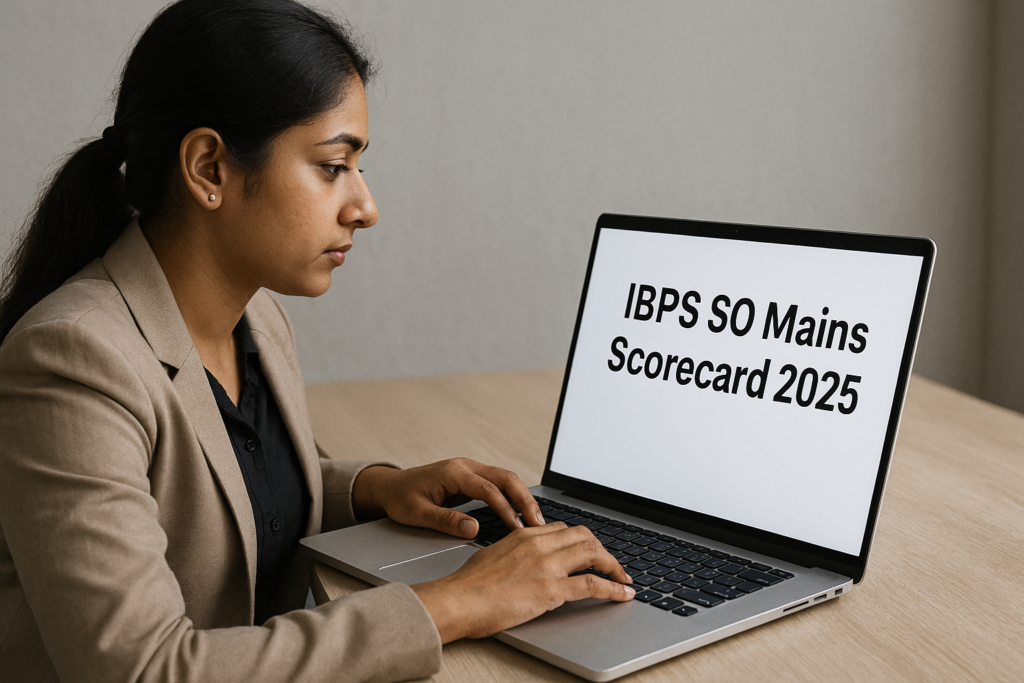
IBPS SO Mains Scorecard 2025 is more than just marks — it reveals your real standing in the Specialist Officer race.
This guide breaks down score meaning, cutoff logic, mistakes, and what serious aspirants must do next.

Table of Contents
Introduction
For thousands of banking aspirants, the release of the IBPS SO Mains Scorecard 2025 is not just a routine update — it’s an emotional checkpoint.
Weeks of preparation, sleepless nights, and high expectations finally translate into a single scorecard that can either open the interview door or force a rethink of strategy.
But here’s the truth most blogs won’t tell you:
Your marks alone don’t decide your future — your understanding of them does.
In this detailed guide, you’ll learn:
How to read and interpret the IBPS SO mains scorecard correctly
Why candidates with similar marks face different outcomes
What data-backed trends tell us about shortlisting logic
Common mistakes aspirants make after scorecard release
Clear, actionable next steps — whether you’re shortlisted or not
This is not an announcement recap. This is analysis + direction.
Understanding the IBPS SO Mains Scorecard 2025 (Beyond Numbers)
At first glance, the IBPS SO Mains scorecard looks straightforward — section-wise marks, total score, and status.
But experienced candidates know this is only the surface layer.
What the Scorecard Actually Represents
Your scorecard reflects:
Relative performance, not absolute excellence
How you performed against others in your category & post
The difficulty level of your specific shift
Unlike board exams, IBPS follows a normalization-based evaluation, meaning:
Two candidates with the same raw score may not have the same normalized score.
This is why cutoff understanding is more important than marks obsession.
IBPS SO Posts & Why Cutoffs Differ Drastically
One critical mistake aspirants make is comparing scores across posts.
Specialist Officer Posts Covered
IT Officer
Agriculture Field Officer
HR/Personnel Officer
Marketing Officer
Law Officer
Rajbhasha Adhikari
Each post has:
Different vacancy counts
Different candidate competition ratios
Different subject difficulty levels
Real Example (Past Trend Insight)
In previous cycles:
IT Officer cutoffs were higher due to technical scoring ease
Law Officer cutoffs fluctuated sharply due to fewer candidates
Rajbhasha cutoffs remained unpredictable due to language expertise filtering
Lesson: Never judge your chances using someone else’s post score.
Score vs Cutoff: Why “Just Clearing” Is Not Enough
Many candidates celebrate clearing the cutoff — and then panic later.
The Hidden Reality
IBPS does not call all cutoff-clearing candidates equally.
Shortlisting depends on:
Vacancy-to-candidate ratio
Category-wise merit ranking
Interview weightage planning
Clearing cutoff = Eligibility
Ranking high above cutoff = Advantage
Table: How Scorecard Elements Impact Final Selection
| Scorecard Element | Why It Matters | Impact Level |
|---|---|---|
| Sectional Marks | Minimum qualifying barrier | Medium |
| Total Normalized Score | Determines rank | High |
| Category Cutoff | Eligibility filter | High |
| Post-wise Cutoff | Competition indicator | Very High |
| Interview Performance | Final merit shaping | Critical |
Case Scenario: Two Candidates, Same Marks — Different Outcomes
Candidate A
IT Officer
Score: Slightly above cutoff
Category: General
Result: Waitlisted / Not finally selected
Candidate B
Agriculture Field Officer
Same score
Category: OBC
Result: Interview call + Final selection
Why?
Different vacancy density
Different post demand
Different category normalization
Scorecards don’t exist in isolation — they live inside data ecosystems.
Common Mistakes Aspirants Make After Scorecard Release
Mistake 1: Panic Comparison
Comparing your marks with Telegram screenshots without context leads to wrong conclusions.
Mistake 2: Ignoring Interview Preparation
Many shortlisted candidates start interview prep too late, assuming marks will carry them.
Mistake 3: Overconfidence After High Score
Strong mains marks don’t guarantee final selection if interview performance is weak.
Mistake 4: Giving Up Too Early
Candidates just below cutoff often stop preparing — ignoring future cycles where experience matters.
Actionable Steps Immediately After Checking IBPS SO Mains Scorecard 2025
Step 1: Categorize Your Status
Well above cutoff
Borderline
Below cutoff
Each category requires a different action plan, not the same reaction.
Step 2: Start Interview Prep (If Eligible)
Focus on:
Domain knowledge
Banking awareness
Role-specific scenarios
Step 3: Analyze Weak Sections
Even if shortlisted, identify:
Accuracy issues
Time management gaps
Subject depth limitations
This helps not just interviews, but future banking exams.
What Toppers Do Differently
Experienced IBPS qualifiers don’t wait for results to define them.
They:
Track trend data, not rumors
Treat every scorecard as feedback, not judgment
Prepare interviews as final exams, not formalities
That mindset — not luck — separates repeat failures from consistent rankers.
What You Should Be Thinking Right Now
Ask yourself:
Do my marks reflect my true preparation level?
Did I attempt smartly or emotionally?
Can I defend my answers in an interview scenario?
Your scorecard is not a verdict.
It’s a diagnostic report.
IBPS SO Interview Shortlisting Logic: How IBPS Decides Who Gets the Call
Once the IBPS SO Mains scorecard 2025 is released, the next big question is not “Did I qualify?” but “Will I actually get an interview call?”
This is where many aspirants misunderstand the process.
How Interview Shortlisting Really Works
IBPS does not invite candidates randomly or generously. The interview shortlist is decided based on:
Post-wise vacancies
Category-wise vacancy breakup
Merit ranking (not just cutoff clearance)
Score normalization across shifts
For every Specialist Officer post, IBPS usually calls candidates in a ratio higher than vacancies, but not excessively.
Example logic (illustrative, not official):
Vacancies: 100
Interview calls: 200–250
So if you are just marginally above the cutoff, your chances depend on:
How many candidates scored above you
How wide the score distribution is
This is why rank position matters more than emotional hope.
IBPS SO Final Selection Formula: Marks That Truly Matter
Many candidates believe mains marks alone decide final selection. That is only partially true.
Weightage Structure (Conceptual Understanding)
Mains Exam: Major weightage
Interview: Decisive weightage
Even a strong mains score can be neutralized by:
Poor interview performance
Weak domain clarity
Lack of role understanding
And yes — candidates with average mains marks but strong interviews have cracked final selection.
Interview Stage: What IBPS Panels Actually Evaluate
IBPS interviews are not about trick questions. They are about role-fit.
Core Areas Assessed
Domain expertise (post-specific)
Practical application knowledge
Banking & financial awareness
Communication clarity
Decision-making ability
Example Scenario
An IT Officer candidate scoring high in mains but unable to explain:
Basic banking software use-cases
Cybersecurity relevance in banks
…will struggle, regardless of marks.
Marks get you the seat. Knowledge keeps you there.
What If You’re Not Shortlisted? (Most Ignored Section)
This is where serious aspirants separate themselves.
First: Don’t Personalize the Result
IBPS results are:
Vacancy-driven
Ratio-driven
Category-adjusted
Not qualifying does not mean you’re incapable.
Smart Recovery Strategy
Identify weak sections from scorecard
Compare your score gap (not emotions)
Prepare for:
Next IBPS cycle
SBI SO
Other regulatory exams
Candidates who treat rejection as data, not defeat, usually succeed within 1–2 cycles.
Mistakes to Avoid After IBPS SO Mains Scorecard 2025
Mistake 1: Stopping Preparation Entirely
Waiting for “next year” kills momentum.
Mistake 2: Over-Preparing Only Theory
Interviews demand application, not memorization.
Mistake 3: Blindly Following Telegram Advice
Most advice lacks context of post, category, and vacancy math.
Mistake 4: Ignoring Interview Mock Feedback
Mocks are diagnostic tools — not judgment platforms.
Comparison: IBPS SO vs Other Banking Specialist Exams
| Factor | IBPS SO | SBI SO | Other PSU Exams |
|---|---|---|---|
| Competition | Very High | Extremely High | Moderate |
| Transparency | High | Medium | Varies |
| Interview Impact | High | Very High | Medium |
| Domain Depth | Moderate–High | High | Role-specific |
This comparison shows why IBPS SO remains a benchmark exam for specialist roles.
What Repeated Qualifiers Know
Candidates who qualify IBPS SO repeatedly understand one thing:
Banking exams reward consistency, not miracles.
They:
Track post-wise trends
Prepare interviews early
Treat every failure as structured feedback
That’s experience talking — not motivation quotes.
Summary: What This Scorecard Is Telling You
Your preparation level
Your competitive position
Your readiness for professional roles
Your gaps — technical or strategic
Ignoring these insights is the biggest loss, bigger than non-selection.
Frequently Asked Questions (FAQs)
1. Is IBPS SO Mains scorecard enough for final selection?
No. Interview performance plays a crucial role in final merit.
2. Does category affect IBPS SO interview calls?
Yes. Cutoffs and shortlisting are category-wise.
3. Are interview marks disclosed?
IBPS releases combined final scores, not always detailed interview breakdowns.
4. Can someone below cutoff still get selected?
No. Cutoff clearance is mandatory.
5. Is normalization applied in IBPS SO mains?
Yes. Scores are normalized across shifts.
6. How many candidates are called for interview?
Usually 2–2.5 times the number of vacancies.
7. Does higher mains score guarantee selection?
No. Poor interview performance can offset high mains marks.
8. Should I prepare again if I narrowly missed cutoff?
Absolutely. Borderline candidates often succeed next cycle.
Conclusion
The IBPS SO Mains Scorecard 2025 is not the end of your journey — it’s a checkpoint.
Some will move forward immediately. Others will take a longer, wiser route.
Both paths can lead to selection — if you stay analytical, disciplined, and patient.
Call to Action (CTA)
Every serious aspirant reaches a moment where clarity matters more than motivation.
If your scorecard has raised questions —
If you want direction instead of confusion —
If you’re serious about wearing that Specialist Officer badge —
Pause. Reflect. Prepare smartly.
Because the right strategy today decides where you stand tomorrow.