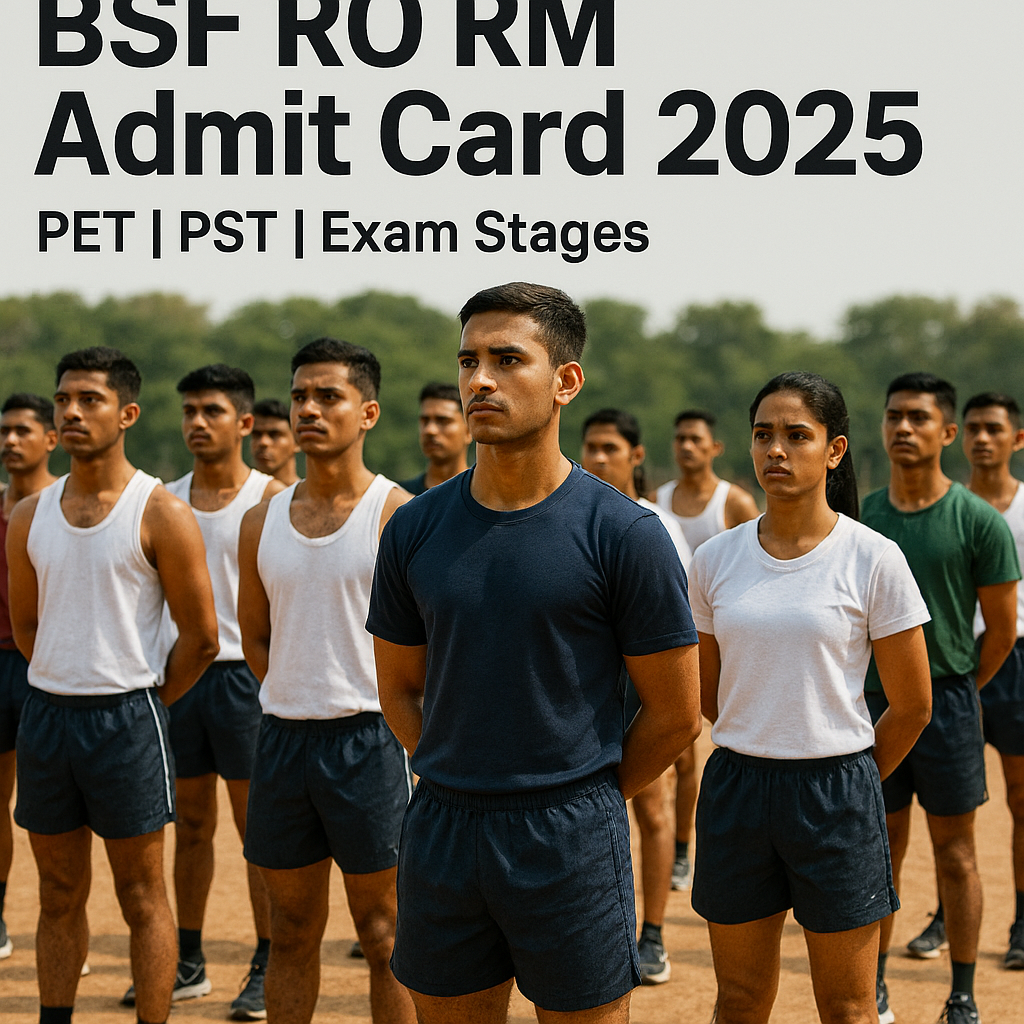
The BSF RO RM Admit Card 2025 is the most critical document for candidates appearing in the PET/PST stage.
This guide explains what the admit card really means, how to prepare smartly, and what mistakes can cost you selection.

Table of Contents
Introduction
For thousands of aspirants who applied for the BSF Head Constable Radio Operator (RO) and Radio Mechanic (RM) recruitment, the release of the BSF RO RM Admit Card 2025 is not just an update — it is a turning point.
This admit card marks the shift from waiting mode to action mode.
Until now, preparation was theoretical. From this stage onward, performance becomes visible, measurable, and decisive.
In this article, you will clearly understand:
What the BSF RO RM admit card truly signifies in the selection process
How PET/PST differs from written exams
Real mistakes candidates make at this stage
Practical preparation strategies that actually work
A comparison between selected vs rejected candidates at PET/PST
This is not a surface-level guide. It is written to help you avoid elimination, not just appear for the exam.
Understanding the Importance of BSF RO RM Admit Card 2025
Many candidates treat the admit card as a mere entry pass.
In reality, it is a filtering checkpoint used by BSF to reduce the applicant pool sharply.
At the PET/PST stage:
No marks are awarded
No grace is given
No second chance is promised
You either qualify or exit.
This makes the admit card phase more decisive than the written exam for many candidates.
What Happens After the Admit Card Is Issued?
Once the BSF RO RM admit card 2025 is released, three things happen immediately:
Your exam city and reporting time are locked
Your physical readiness is tested, not your memory
Competition shifts from knowledge-based to endurance-based
This is where many academically strong candidates fail — because physical preparation is delayed or ignored.
PET/PST Stage: Why Most Candidates Get Eliminated Here
Let’s be very honest.
Most rejections at the RO RM level do not happen due to:
Lack of intelligence
Poor subject knowledge
Technical inability
They happen due to:
Overconfidence
Casual physical preparation
Ignoring instructions on the admit card
A Realistic Scenario
Two candidates reach PET/PST:
Candidate A
Strong academically
Started physical prep only after admit card
Missed running timing by seconds
Candidate B
Average academically
Started jogging and stamina training weeks earlier
Cleared PET comfortably
Result:
Candidate B moves forward. Candidate A exits.
This is the brutal truth of uniformed services recruitment.
What the Admit Card Tells You (Beyond Date & Venue)
The BSF RO RM admit card 2025 silently communicates much more than candidates realize.
It tells you:
The exact reporting discipline expected
Documentation seriousness
Whether PET/PST will be strict or lenient (based on venue instructions)
How early you must mentally and physically prepare
Ignoring these signals leads to avoidable disqualification.
Key Details to Cross-Verify on Admit Card
Before anything else, candidates must carefully verify:
Name spelling (as per documents)
Roll number and post applied
PET/PST venue address
Reporting time vs gate closing time
Instructions regarding footwear, clothing, and documents
Common Mistake
Candidates check the date but ignore reporting instructions, leading to late entry rejection.
Physical Efficiency Test (PET): Reality vs Expectation
Many candidates believe:
“I’m generally fit, PET will be easy.”
This assumption alone eliminates thousands.
PET is not about “general fitness”.
It is about meeting exact standards under pressure.
Even a small delay, improper footwear, or fatigue can cause failure.
Physical Standard Test (PST): Silent Eliminator
PST looks simple on paper:
Height
Chest (for male candidates)
Weight (proportionate)
But practical reality differs.
Where Candidates Lose Out:
Incorrect posture during measurement
Nervous breathing affecting chest measurement
Not knowing relaxation techniques
These are not taught in books — only experience and awareness help.
Table: PET/PST Focus Areas for RO & RM Candidates
| Stage | What BSF Checks | Common Candidate Mistake |
|---|---|---|
| PET | Endurance & stamina | Starting prep too late |
| PST | Physical standards | Panic during measurement |
| Docs | Authenticity | Missing minor certificates |
| Discipline | Military conduct | Casual attitude |
Actionable Steps After Downloading Admit Card
Once you download your BSF RO RM admit card 2025, follow this checklist:
Step 1: Fix Your Travel Plan
Reach city at least one day early
Avoid same-day long travel
Step 2: Start Light Physical Routine
Brisk walking / jogging
Stretching exercises
Breathing control
Step 3: Document Folder Preparation
Original certificates
Photocopies
Admit card printouts (multiple)
Step 4: Mental Conditioning
Sleep schedule adjustment
Avoid last-minute panic
Visualize successful completion
Mistakes to Avoid at This Stage
Avoid these career-costing mistakes:
Wearing new shoes on PET day
Ignoring hydration
Overtraining just before PET
Depending on last-minute fitness
Not reading admit card instructions fully
One careless decision can undo years of preparation.
Case Comparison: Selected vs Rejected Candidate
| Factor | Selected Candidate | Rejected Candidate |
|---|---|---|
| Physical prep | Started early | Started after admit card |
| Mindset | Calm & disciplined | Overconfident |
| Documentation | Complete & organized | Missing copies |
| Reporting | Early arrival | Last-minute rush |
Selection is rarely accidental.
Rejection often is.
Why BSF Is Strict at PET/PST
From an examiner’s perspective:
BSF requires operational readiness
RO/RM roles involve field deployment
Physical reliability matters as much as technical skill
Strict PET/PST is not cruelty — it is necessity.
Understanding this mindset helps candidates prepare correctly.
What Comes After PET/PST? (Preview)
Candidates who clear this stage move towards:
Written examination
Skill/technical assessment
Medical examination
Final merit consideration
But none of this matters if PET/PST is not cleared.
What Happens After PET/PST Clearance?
Clearing PET/PST after downloading the BSF RO RM admit card 2025 places you among a much smaller, serious pool of candidates. From this stage onward, selection becomes more technical, disciplined, and documentation-driven.
Unlike PET/PST, the next stages involve:
Written knowledge assessment
Role-specific understanding (RO vs RM)
Medical fitness verification
Final merit-based ranking
Every stage builds on the previous one. A weak link anywhere can halt the process.
Written Examination: What BSF Actually Tests
The written exam is not designed to test how much you have memorized.
It tests how reliable you are under operational pressure.
Key Focus Areas:
Basic electronics & communication concepts
Reasoning and situational judgement
General awareness relevant to service life
Example Insight:
Candidates who focus only on previous-year questions often struggle when questions are framed around application-based logic rather than direct theory.
RO vs RM: Understanding the Difference Matters
Many candidates make the mistake of preparing both posts in the same way.
This often leads to confusion and underperformance.
Comparison Table: RO vs RM Role Focus
| Factor | RO (Radio Operator) | RM (Radio Mechanic) |
|---|---|---|
| Core Skill | Communication handling | Equipment maintenance |
| Exam Focus | Signal & transmission basics | Circuit & repair logic |
| Field Role | Operational coordination | Technical support |
| Preparation Style | Concept clarity | Practical understanding |
Knowing which role you applied for helps you prepare precisely, not broadly.
Medical Examination: The Most Underrated Stage
The medical test is where disciplined candidates succeed quietly.
Common Medical Rejection Reasons:
Vision issues
Hearing inconsistencies
Poor dental health
Uncontrolled weight fluctuations
Practical Advice:
Start regulating sleep, diet, and hydration immediately after PET/PST.
Medical fitness is not built in one week — it reflects lifestyle.
Documentation Verification: Silent but Strict
Documentation errors rarely get public attention, but they eliminate many candidates.
What BSF Checks:
Date consistency across certificates
Name spelling alignment
Category authenticity
Educational qualification timelines
Case Insight:
Candidates rejected here often say:
“Everything else was fine, only one document issue.”
In recruitment, one issue is enough.
Final Merit List: How It Is Decided
The final merit list is prepared by combining:
Written exam performance
Category-wise reservation norms
Medical fitness status
Importantly, clearing all stages does not guarantee selection if merit position is low.
Reality Check:
Selection depends not just on qualifying, but on relative performance.
What If Your Name Is Not in the Merit List?
Not getting selected does not mean failure.
Many candidates who clear PET/PST but miss final selection later succeed in:
Next BSF cycle
Other CAPF recruitments
State police technical roles
Experience gained at this level is never wasted.
Mistakes Candidates Make After PET/PST
Avoid these post-PET/PST mistakes:
Relaxing too early
Ignoring written exam seriousness
Neglecting health discipline
Assuming selection is “almost done”
The toughest competition is after PET/PST, not before.
Why Multi-Stage Filtering Exists
From an institutional standpoint:
BSF recruits for long-term service
Technical posts demand consistency
Multi-stage selection reduces risk
Understanding this logic helps candidates align mindset with system expectations.
Table: Full Selection Journey at a Glance
| Stage | Nature | Risk Level |
|---|---|---|
| PET/PST | Qualifying | High |
| Written Exam | Scoring | Very High |
| Medical | Qualifying | Medium |
| Merit List | Competitive | Extreme |
Frequently Asked Questions (FAQs)
1. Is the BSF RO RM admit card 2025 required at every stage?
Yes, candidates must carry it at PET/PST and subsequent stages as instructed.
2. Does clearing PET/PST guarantee selection?
No. PET/PST only qualifies you for further stages.
3. Is the written exam tougher than PET?
It is tougher in a different way — mentally rather than physically.
4. Can RM candidates apply RO preparation strategy?
Not recommended. Role-specific focus yields better results.
5. Are medical standards very strict?
They are standardized and strictly enforced.
6. What happens if documents have minor errors?
Even small discrepancies can lead to rejection.
7. Is age relaxation considered at later stages?
Age eligibility is verified during document checks.
8. Can candidates improve chances after PET/PST?
Yes, through focused written prep and health discipline.
Conclusion
The journey that begins with the BSF RO RM Admit Card 2025 is demanding, disciplined, and deeply transformative.
This recruitment process rewards:
Preparation over luck
Discipline over confidence
Consistency over shortcuts
Candidates who understand this reality stand apart.
Call to Action (CTA)
Every uniform earned represents patience, effort, and self-belief.
If you are on this path, stay committed to daily progress — even when results feel distant.
Success in defence services is rarely sudden.
It is built quietly, step by step, by those who refuse to quit.