CLAT Results 2026 are out. This in-depth guide explains AIR 1 performance, result trends, score analysis, counselling strategy, and what aspirants must do next to secure top NLUs.

Table of Contents
Introduction
The declaration of CLAT Results 2026 is not just a result announcement—it is a decisive turning point in the academic journey of more than one lakh law aspirants across India. For some, the result confirms years of disciplined preparation. For others, it becomes a moment of reassessment, learning, and strategic recalibration.
Unlike earlier years, CLAT 2026 results reveal deeper shifts in performance patterns, gender distribution, city-wise dominance, and rank-to-score volatility. These results are not merely numbers; they tell a story about evolving competition, smarter preparation strategies, and the increasing importance of decision-making after results—especially during counselling.
In this comprehensive guide, you will learn:
What the CLAT 2026 results truly indicate beyond ranks
How AIR 1 and top rankers approached the exam
Score and rank trends compared to previous years
Common mistakes students make after results
A step-by-step counselling and admission strategy
Practical insights backed by data and real scenarios
This is not a basic result article. This is a decision-making guide for aspirants and parents.
Understanding CLAT Results 2026: What Changed This Year?
The CLAT consortium released the results amid intense anticipation, and several notable patterns immediately stood out.
1. Higher Competition, Narrower Margins
In CLAT 2026, the score gap between ranks compressed significantly. A difference of just 2–3 marks resulted in rank swings of hundreds—especially within the top 3000.
This indicates:
Better-prepared candidates overall
Fewer easy questions
Increased importance of accuracy over attempts
2. Gender & City-wise Performance Trends
One of the most discussed aspects of CLAT results 2026 is the strong performance of female candidates and aspirants from Tier-2 and Tier-3 cities.
This challenges the earlier belief that metro cities dominate top ranks and shows:
Access to quality online preparation has leveled the field
Strategy now matters more than location
3. Reading-Based Sections Became Rank Deciders
Legal Reasoning and Reading Comprehension sections played a decisive role. Students who focused on depth over speed gained an edge.
CLAT 2026 AIR 1: What Sets the Topper Apart?
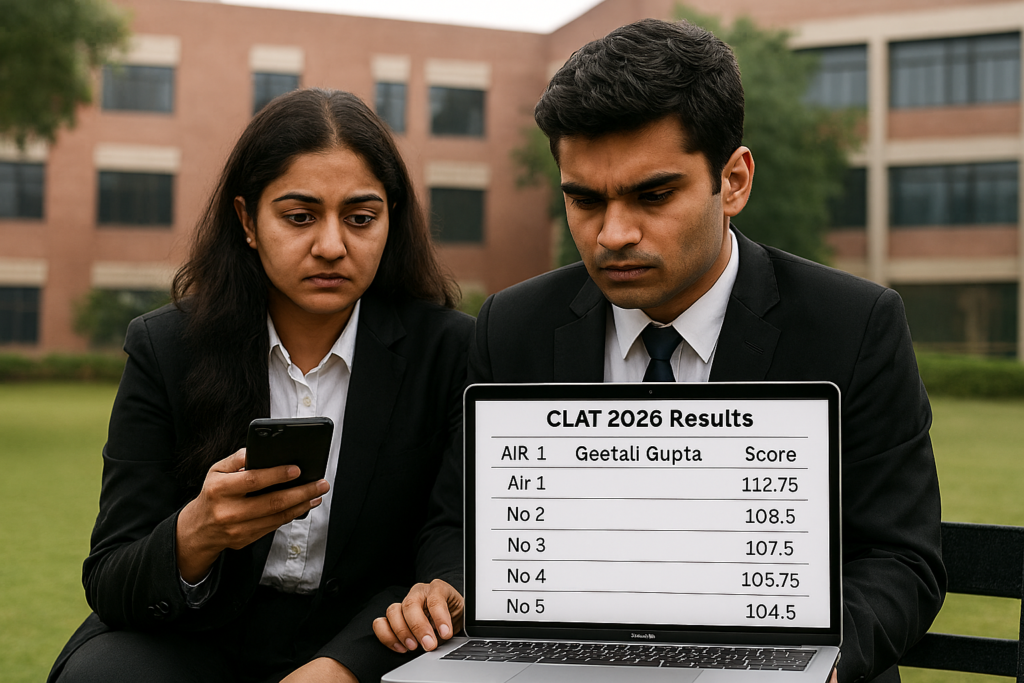
Every year, aspirants search for “AIR 1 CLAT 2026” not out of curiosity—but to decode success.
Key Observations from AIR 1 Performance
Although preparation styles differ, AIR 1 candidates generally share common traits:
Strong reading habit over rote learning
Consistent mock analysis, not mock obsession
Calm exam temperament
Clear prioritization of accuracy
Example Scenario
Consider two students:
Student A attempted 115 questions with 85% accuracy
Student B attempted 95 questions with 95% accuracy
In CLAT 2026, Student B consistently ranked higher.
Lesson:
CLAT is no longer about maximum attempts—it is about controlled precision.
CLAT Result 2026: Score vs Rank Reality Check
Many aspirants misinterpret their results because they fail to understand rank relativity.
Approximate Score–Rank Trend (Indicative)
| CLAT Score Range | Expected Rank Range |
|---|---|
| 90–95 | Top 100 |
| 85–89 | 100–500 |
| 78–84 | 500–1500 |
| 70–77 | 1500–3000 |
| 60–69 | 3000–6000 |
⚠️ Note: These ranges fluctuate yearly based on difficulty and normalization.
Expert Insight
Instead of comparing raw scores with friends, compare college cut-off alignment. Rank utility matters more than rank vanity.
Consortium of NLUs & Result Interpretation
The Consortium of NLUs conducts CLAT, but admission outcomes depend on multiple post-result variables:
Category
Domicile
Seat matrix
Counselling preferences
Withdrawal behavior
Many students with higher ranks fail to secure top NLUs due to poor preference filling.
Common Mistakes Students Make After CLAT Results
Mistake 1: Panic-Based Decisions
Students either overestimate or underestimate their chances based on rank alone.
Mistake 2: Ignoring Lower NLUs
Several mid-ranked NLUs now offer:
Better internships
Strong alumni networks
Specialized programs
Mistake 3: Delayed Counselling Registration
Missing deadlines is one of the most costly and avoidable mistakes.
Actionable Steps After CLAT Result 2026 (Immediate)
Download and save scorecard (multiple copies)
Analyze rank vs seat matrix
Shortlist NLUs realistically
Prepare counselling documents
Track consortium notifications daily
Case Example: Rank Isn’t Everything
A student with AIR 1800 chose a mid-tier NLU with strong corporate law exposure. Another with AIR 900 insisted on a top NLU but dropped out due to mismatch.
Outcome after 3 years:
The AIR 1800 student secured a Tier-1 law firm internship earlier.
Takeaway:
Fit matters more than brand obsession.
Key Learnings So Far
CLAT Results 2026 show tighter competition
AIR 1 success reflects accuracy-first strategy
Score vs rank interpretation is crucial
Counselling decisions define final outcomes
CLAT 2026 Counselling: Strategy That Actually Works
Counselling is where most aspirants lose their advantage.
Step-by-Step Counselling Framework
Tier-wise NLU classification
Tier 1: Top legacy NLUs
Tier 2: Emerging NLUs with strong placement growth
Tier 3: New NLUs with niche advantages
Preference Filling Rule
Never skip an NLU assuming it is “below your rank”
Always fill maximum realistic preferences
Freeze vs Float Decision
Freeze only when satisfied
Float when rank allows upward movement
CLAT 2026 vs CLAT 2025: Key Comparison
| Factor | CLAT 2025 | CLAT 2026 |
|---|---|---|
| Difficulty | Moderate | Moderate–High |
| Rank Volatility | Medium | High |
| Accuracy Impact | Medium | Very High |
| Cut-off Stability | Stable | Fluctuating |
Mistakes to Avoid During Counselling
Overconfidence due to rank
Ignoring domicile advantages
Not researching NLU culture
Emotional decisions influenced by peers
What Toppers & Experts Agree On
CLAT success is process-driven, not luck-driven
Results matter, but adaptability matters more
Counselling knowledge is a competitive advantage
Conclusion: What CLAT Results 2026 Really Mean
The CLAT Results 2026 are not the end of your journey—they are the beginning of informed decision-making. Whether your rank exceeded expectations or fell short, your future still depends on strategic choices, not a single exam day.
Law careers are built over years, not ranks.
Stay calm. Stay informed. Decide wisely.
Call to Action (CTA)
Your CLAT result is not a verdict on your potential—it is a starting point.
What truly matters now is clarity, patience, and the courage to make informed choices.
Take time to understand your options, trust the process, and move forward with confidence.
The right decision today can shape a rewarding legal career tomorrow.
Stay focused. Stay informed. Your journey in law has only just begun.
Frequently Asked Questions (FAQs)
1. When were CLAT Results 2026 declared?
The CLAT consortium released the results in December 2025 after final answer key evaluation.
2. Is CLAT 2026 rank more important than score?
Rank matters for admission, but score helps assess competitiveness and counselling options.
3. Who got AIR 1 in CLAT 2026?
AIR 1 was secured by a candidate demonstrating high accuracy and strategic section management.
4. What is a safe rank for top NLUs?
Generally, ranks within top 150 are considered competitive for top-tier NLUs.
5. Can I still get an NLU with a rank above 3000?
Yes, depending on category, domicile, and preference strategy.
6. Is counselling mandatory after CLAT result?
Yes, without counselling registration, admission is not possible.
7. Are mid-tier NLUs worth joining?
Many offer strong academic and placement outcomes when chosen wisely.
8. What should I do if I’m unhappy with my CLAT result?
Re-evaluate options, consider partial drops, or explore alternative law entrances.