A complete 2025 guide to Lucknow University covering exams, date sheets, student experience, academic structure, and expert insights to help you prepare better.

Table of Contents
Lucknow University is one of India’s oldest and most respected institutions, shaping generations of students through its academic excellence, diverse programs, and evolving digital education ecosystem. From releasing updated exam schedules to modernizing the admission system, the university has increasingly focused on transparency and student empowerment.
This comprehensive guide helps students understand how Lucknow University functions, how to navigate exam updates, how to manage semester expectations, and how to make the most of their academic experience.
Introduction
Every academic year at Lucknow University begins with anticipation, planning, and the excitement of new possibilities. But alongside this excitement, students struggle with an equally intense pressure—exam schedules, form deadlines, assignment submissions, and staying updated with university notifications.
If you’ve ever waited late at night refreshing the university portal for the updated date sheet, you’re not alone. For thousands of LU students, staying informed is half the battle.
This blog gives you everything you need to understand:
How Lucknow University releases exam schedules
How semester patterns work
What students should do before and after receiving the date sheet
How to plan your study cycle
Common mistakes students make
Expert-backed strategies to improve performance
By the end, you’ll understand Lucknow University not just as an institution—but as a system you can master.
Understanding Lucknow University’s Academic Structure
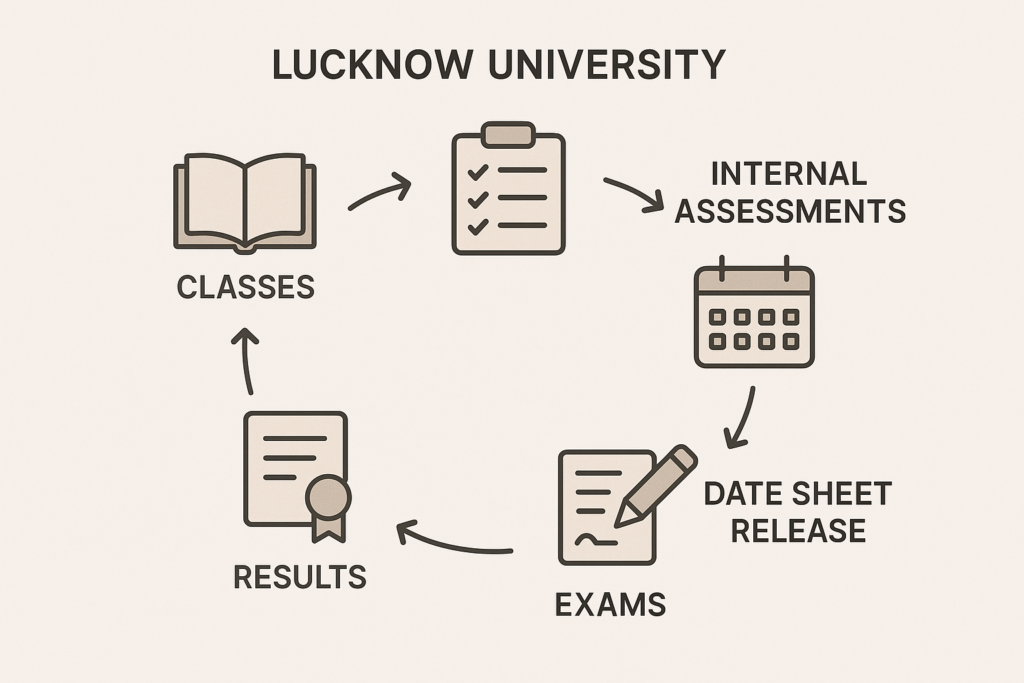
Lucknow University follows a semester-based structure for most undergraduate and postgraduate programs. Each semester focuses on four main pillars:
1. Classroom Learning
From BA to BSc, BCom to LLB, LU maintains a balance between theory and practical learning. Departments frequently update syllabus outlines to reflect modern industry demands.
2. Continuous Internal Evaluation (CIE)
Students are evaluated through:
Assignments
Mid-semester tests
Practical assessments
Attendance score
CIE is extremely important because even a minor score gap affects your semester result.
3. End-Semester Examination (ESE)
These are typically held twice a year—odd and even semesters.
4. Skill Development Add-ons
Many departments offer extra certificate courses, workshops, and FDPs that contribute to the student’s academic portfolio.
How Lucknow University Releases Exam Date Sheets
Every year, LU releases the odd semester and even semester exam schedules in a structured process.
What Students Should Understand
The date sheet is not simply a list of exam dates—it’s a reflection of the university’s overall academic timeline. It also sets the student’s preparation rhythm.
Typical Pattern Followed
Step 1: Department submits paper structure
Step 2: Exam cell formulates the time table
Step 3: Controller of Examination approves draft
Step 4: Final date sheet released on the official portal
LU is known for releasing schedules in multiple iterations—sometimes with revisions to adjust for pending practicals or departmental requests.
Why Date Sheet Updates Matter for Students
Many students underestimate the importance of closely monitoring date sheet releases. But missing just one update can lead to:
Overlapping schedules
Incomplete preparation
Wrong exam hall reporting
Missing revised dates
Real-Life Scenario
A group of BCom second-year students in 2024 prepared for their exam scheduled on December 15. But a last-minute revision moved the exam to December 14. Students who checked the portal on time avoided panic—others didn’t.
This example highlights why academic awareness is essential.
How to Approach Your Semester Once the Date Sheet Is Released
Here’s a structured approach for LU students:
1. Organize Your Syllabus Immediately
Break down each subject into units and prepare a study cycle.
2. Identify High-Scoring Units
LU papers often have predictable patterns. Identify chapters that consistently carry maximum marks.
3. Prepare a Weekly Calendar
A visual schedule helps you balance assignments, practicals, and theory preparation.
4. Start with Revision of Familiar Topics
This helps boost confidence and reduces last-minute stress.
5. Mock Tests & Previous Papers
Many toppers claim that LU’s repetitive patterns make previous papers gold.
Table for Student Understanding – LU Academic & Exam Cycle
Here is a structured table that visually explains how Lucknow University’s academic cycle flows:
| Stage | Timeline | What Students Must Do |
|---|---|---|
| Academic Session Begins | July–August | Attend classes, maintain attendance |
| Mid-Semester Assessments | September–October | Submit assignments & projects |
| Odd Semester Date Sheet Release | November | Start revision and solve previous papers |
| Odd Semester Exams | December | Written + practical examination |
| Semester Break | January | Rest + prepare backlog (if any) |
| Even Semester Classes | February–March | Resume regular classes |
| Even Semester Exams | May–June | Final evaluation of academic year |
This table helps students visualize the entire academic year at a glance.
Key Challenges Lucknow University Students Face
Every university has its unique dynamics, and LU students often share these concerns:
1. Multiple Date Sheet Revisions
Uncertainty often affects preparation cycles.
2. Practical Exam Scheduling
Practical exams may be conducted department-wise, leading to overlaps.
3. Gap Between Papers
Some papers have long gaps while others have back-to-back scheduling.
4. Communication Gaps
Not all students regularly check official notifications.
5. Balancing Internals + Externals
Assignments and internal marks significantly affect final results.
Why Understanding the Exam Cycle Improves Performance
When students understand the university’s timeline, they can:
Improve their study flow
Avoid last-minute rush
Maintain consistency
Plan group studies
Organize notes better
A student who prepares based on LU’s exam cycle always stays ahead.
Common Mistakes Lucknow University Students Make (and How to Avoid Them)
Even the most hardworking students often lose marks—not because they lack knowledge, but because of avoidable mistakes within the LU exam ecosystem. Let’s break down the most common errors and what you can do differently.
1. Depending Too Much on Last-Minute Notes
Many LU students study from shortcut notes made by seniors or peers.
While helpful, these rarely cover the full syllabus.
Avoid this by:
Reading at least the primary chapters from textbooks
Making your own summary notes
Reviewing classroom handouts regularly
2. Not Checking Date Sheet Updates Regularly
Lucknow University frequently issues revised schedules.
Avoid this by:
Checking notifications daily during exam month
Maintaining a screenshot of the latest date sheet
Reconfirming practical exam schedules with your department
3. Ignoring Internal Marks
Internal assessments contribute heavily to final results.
Avoid this by:
Submitting all assignments on time
Attending internal tests seriously
Maintaining at least 75% attendance
4. Poor Time Management
Some students excel in one subject but ignore another.
Avoid this by:
Making a subject-wise time allocation chart
Studying high-priority subjects early
Balancing theory + practical subjects
5. Not Solving LU Previous Year Papers
LU exams often repeat 30–40% question patterns.
Avoid this by:
Solving 5–10 years of PYQs
Practicing expected long answers
Evaluating speed and accuracy
6. Misjudged Practical Preparation
Students often revise theory but neglect practical file submission and viva.
Avoid this by:
Completing practical files at least 15 days before exam
Practicing experiments or viva questions
Asking teachers for sample practical queries
Real-World Case Study – How One LU Student Turned Around His Academic Journey
Let’s explore a real-life inspired story based on LU student experiences.
Case Study: Aarav, BSc Final Year Student
Situation:
Aarav was an average student. He never missed classes but always feared semester exams. His biggest weakness was lack of planning—he waited for the date sheet before starting serious preparation.
Problem:
In his 2nd-year odd semester, the date sheet was revised twice. Because Aarav wasn’t tracking updates, he got the wrong exam date and nearly missed his first paper. Anxiety took over, and his performance dropped.
Turning Point:
During the next semester, Aarav changed his approach:
Started preparing from Day 1
Made unit-wise notes
Set weekly study goals
Checked LU notifications daily
Solved previous papers systematically
Outcome:
He scored above 70%—his best result at LU.
Lesson:
Academic success at Lucknow University is less about last-minute hard work and more about timely awareness, structured study, and consistent revision.
1. Lucknow University Follows Predictable Question Trends
Analysis of recent LU papers shows:
Weighted importance on descriptive answers
Focus on conceptual clarity
Repetitive long-answer patterns
Understanding these patterns boosts scoring potential.
2. Internal Marks Create a Major Difference
Students who secure high internal marks often achieve better final grades even if their external performance is average.
3. Practical Exams Hold High Value
For science, commerce, and vocational courses, practical exams significantly impact results. Students who take viva seriously often outperform others.
4. Semester Preparation Should Be Continuous, Not Seasonal
Academic data shows LU toppers maintain a 12-week revision pattern.
Studying only before exams decreases retention.
Actionable Strategy for LU Students (Step-by-Step)
Here’s a 360° strategy that aligns with LU’s academic timeline:
Step 1: Build a Semester Planner
Create a detailed calendar from the first day of class:
Mark internal test dates
Add assignment deadlines
Include personal targets
Step 2: Follow a 3-Phase Preparation Cycle
Phase 1 – Learning (Weeks 1–6)
Attend classes
Make unit notes
Complete practical file preparation
Phase 2 – Consolidation (Weeks 7–10)
Solve previous papers
Attempt mock tests
Start long-answer practice
Phase 3 – Final Revision (Weeks 11–14)
Revise notes
Learn diagrams and definitions
Conduct group discussions
Step 3: Manage Practical Exams Smartly
Don’t rely on last-day preparation
Prepare for viva with real lab experience
Step 4: Exam-Day Strategy
Attempt familiar questions first
Divide time for long vs short answers
Highlight key terms and maintain structure
Summary of Major Points
Lucknow University follows a structured academic cycle
Date sheet awareness is essential for correct preparation
Internal marks and attendance influence final grades
Previous papers are critical for scoring well
Practical exams demand early preparation
Managing semester timelines improves academic performance
Avoid common mistakes like relying only on short notes
Consistency beats last-minute studying
Conclusion
Lucknow University offers immense academic potential—but students who understand its system perform significantly better than those who don’t.
When you stay updated, plan your semester, follow a healthy study rhythm, and take both theory and practical components seriously, you rise above unnecessary stress and perform confidently.
Your success at LU isn’t decided by one exam—it’s built through awareness, preparation, and consistency.
Take charge of your academic journey today—you’ll thank yourself tomorrow.
Call to Action (CTA)
If this guide helped you, share it with fellow Lucknow University students. Bookmark it, start planning your semester today, and take one step closer to achieving your academic goals at LU. Your journey begins now—own it.
Frequently Asked Questions
1. How does Lucknow University announce exam schedules?
Through the official portal via updated date sheets for odd and even semesters.
2. Why do LU date sheets get revised?
Due to departmental adjustments, practical exam alignments, or university-level changes.
3. How important are internal marks at LU?
Extremely important—they significantly improve overall semester grades.
4. How should students prepare for LU practical exams?
By preparing files early, practicing experiments, and revising viva questions.
5. Are LU exams predictable?
Yes, many question patterns repeat from previous years.
6. How often should students check LU notifications?
Daily during exam period, weekly otherwise.
7. Does attendance affect LU results?
Yes—attendance contributes to internal evaluation and exam eligibility.
8. How can students avoid stress during semester exams?
By creating a preparation plan, revising regularly, and practicing question papers.