A comprehensive expert guide on IBPS PO Mains Result 2025, covering expected release analysis, cut-off trends, normalisation, score calculation, and next-stage preparation.
Perfect for candidates seeking deep insights, actionable steps, and exam strategy backed by data and expert experience.
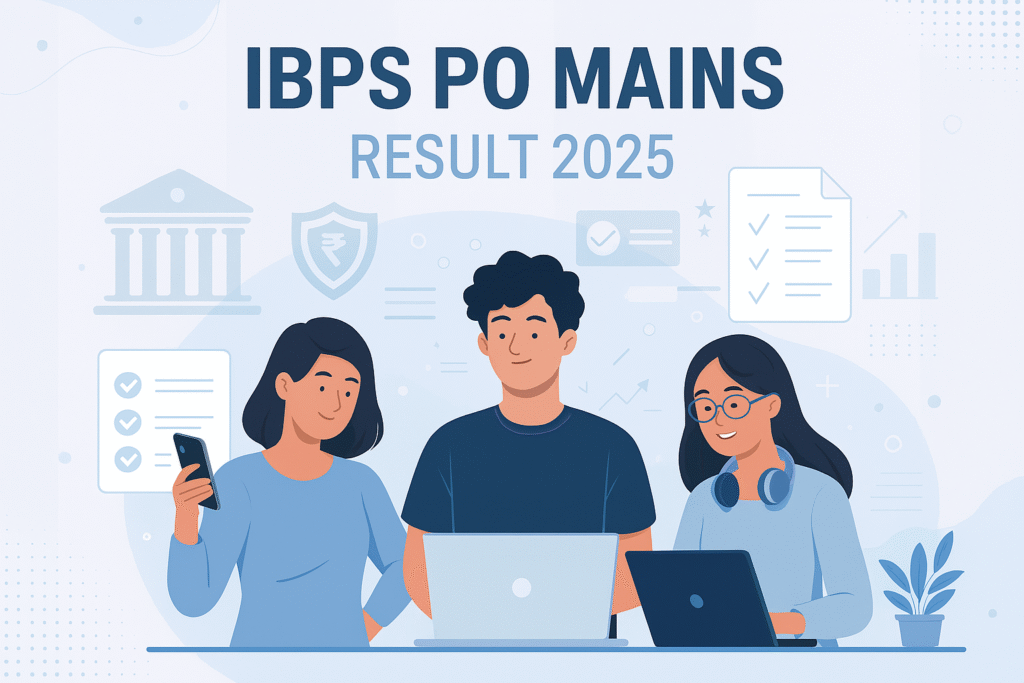
Table of Contents
Introduction
The IBPS PO Mains Result 2025 is one of the most anticipated moments for lakhs of banking aspirants. Every year, the Institute of Banking Personnel Selection conducts the PO recruitment process to shortlist talented candidates for prestigious probationary officer roles across nationalised banks. But what many aspirants do not realise is that understanding the result process deeply—including normalisation, section-level cut-offs, final merit preparation, and score weighting—can significantly influence your preparation strategy and mental readiness for the interview.
Expert analysis of result trends
Expected cut-off insights
Score calculation examples
Normalisation breakdown
Previous year behaviour patterns
Mistakes candidates commonly make
Actionable steps for interview preparation
A case study comparing successful and unsuccessful aspirants
A table summarising score weightage
FAQs (8 questions)
Strong conclusion + motivational CTA
Let’s dive deep into how the IBPS PO Mains Result 2025 works and why a strategic understanding of it can completely change your journey.
The IBPS PO exam is designed to filter candidates with strong decision-making, analytical reasoning, and communication abilities. While the prelims assess basic aptitude, the Mains exam is the real decider, and the result determines:
Your eligibility for the interview
Your position in the merit list
Your overall probability of final selection
Many aspirants focus heavily on the exam but overlook the result mechanics. But the result is not merely about marks; it is about normalisation, relative performance, section-level competition, difficulty-level adjustments, and weightage in final selection.
In other words, your result is not just a score — it is a statistical judgment of your performance against lakhs of candidates.
Understanding the IBPS PO Mains Result Structure
To decode the IBPS PO Mains Result 2025, we must first understand how IBPS evaluates candidates.
The Mains exam includes:
Reasoning & Computer Aptitude
Data Analysis & Interpretation
English Language
General/Economy/Banking Awareness
Descriptive Writing (Essay & Letter)
Each section carries separate marks but the cumulative score is what matters most.
Breakdown of Weightage:
| Stage | Weightage in Final Merit |
|---|---|
| IBPS PO Mains Exam | 80% |
| Interview | 20% |
This table alone tells you why the Mains result is the single most important factor in your selection journey.
Score Normalisation Explained
IBPS uses a normalisation method to adjust scores across multiple shifts.
Why?
Because different shifts may have slightly different difficulty levels.
How it works (example):
Candidate A: Raw Score 78 in a difficult shift
Candidate B: Raw Score 82 in an easier shift
After normalisation:
Candidate A → Normalised Score = 84
Candidate B → Normalised Score = 81
This means difficulty fairness plays a huge role.
Many aspirants do not understand this and panic unnecessarily.
Expected Trends for IBPS PO Mains Result 2025
Based on exam difficulty, student feedback, and previous results, we can analyse the following:
1. Difficulty Level
2025 Mains difficulty was moderate-high, especially in:
DI Caselets
Puzzle-based reasoning
Banking awareness depth
Essay topics
2. Expected Cut-Off Behaviour
Cut-off is influenced by:
Number of vacancies
Difficulty level
Normalisation
Demographics of attempts
General category cut-offs usually fluctuate between 68–81 (normalised).
3. Descriptive Writing Impact
Strong essay-writing often becomes the differentiator.
A Realistic Scenario
Consider two candidates:
Candidate X:
Attempts: High
Accuracy: Moderate
DI: Weak
Essay: Average
Candidate Y:
Attempts: Moderate
Accuracy: High
DI: Strong
Essay: Excellent
Despite fewer attempts, Candidate Y often scores higher due to quality and descriptive performance.
This is the hidden layer of the Mains evaluation most candidates ignore.
Mistakes Candidates Make After the Mains Exam
Mistake 1: Assuming the result depends only on attempts
Quality > Quantity always wins.
Mistake 2: Ignoring descriptive writing
This section alone can shift rankings dramatically.
Mistake 3: Panicking about answer key differences
IBPS never releases official answer keys.
Mistake 4: Not preparing for the interview
Waiting for the result wastes 15–30 crucial days.
Mistake 5: Comparing marks with others without considering normalisation
Raw score ≠ Final score.
Learning from these mistakes is essential for success.
What You Should Do While Waiting for the Result
This is the golden period. Use it properly:
Improve your communication skills
Start mock interviews.
Read banking and financial updates
Panel will assess awareness.
Work on your profile explanation
“Tell me about yourself” can define the entire interview flow.
Practise situational questions
Banks want decision-makers, not just toppers.
Organise your documents
This avoids last-minute panic.
Actionable Preparation Plan (7 Days)
Day 1: Introduction + profile answer + confidence
Day 2: Banking awareness
Day 3: Mock interview
Day 4: HR questions
Day 5: Situational judgement
Day 6: Communication polish
Day 7: Final simulation interview
This 7-day plan gives a competitive edge.
Case Study — Success vs Failure
Case A (Success):
A candidate with:
Moderate attempts
High precision
Excellent essay
Strong interview preparation
Result: Cleared with high merit.
Case B (Failure):
A candidate with:
Very high attempts
Low accuracy
Weak essay
No interview prep
Result: Missed the cut-off despite higher attempts.
This illustrates that strategy > speed.
IBPS PO Mains Result Breakdown — Step-by-Step
When the result is released, candidates will see:
1. Sectional Scores
Indicating performance trend.
2. Overall Score
The decisive factor.
3. Cut-Off Marks
Category-wise.
4. Normalized Score
Adjusted score.
5. Eligibility for Interview
Status indicator.
Understanding Cut-Off Trends Over Time
Cut-off significantly depends on:
Difficulty
Vacancies
Normalisation
Candidate performance
For example:
2019 → 71
2020 → 83
2021 → 75
2022 → 80
2023 → 74
2024 → 77
Fluctuation is normal.
What to Do After the Result Is Out
If selected:
Start interview prep immediately.
If waitlisted:
Stay hopeful; waitlist often moves.
If not selected:
Use the experience for the next cycle instead of emotional stress.
Emotional Stability During Waiting Period
Waiting for results is mentally draining.
Here’s how to stay positive:
Avoid comparison
Focus on preparation
Remind yourself success = consistency
Stay disciplined
Believe in your efforts
How IBPS Calculates Final Merit
Final merit ratio: Mains (80%) + Interview (20%)
Example:
Candidate’s Mains Score: 72/100
Normalised to: 83
Weighted: 83 × 0.80 = 66.4
Interview: 75/100
Weighted: 75 × 0.20 = 15
Final Merit = 66.4 + 15 = 81.4
That’s how selection happens.
FAQs
1. When will IBPS PO Mains Result 2025 be declared?
Usually within 30–45 days of the Mains exam.
2. Will IBPS release answer keys?
No, IBPS never releases answer keys.
3. How is the normalisation applied?
Using a statistical formula adjusting for difficulty across shifts.
4. Is descriptive writing important?
Yes, it plays a major role in rank positioning.
5. What is considered a good Mains score?
Anything above the predicted cut-off with strong accuracy.
6. How many candidates reach the interview stage?
Usually 3 times the number of vacancies.
7. How is the final merit list prepared?
80% Mains + 20% Interview.
8. Can a strong interview compensate for a lower Mains score?
To some extent, but Mains score dominates the final merit.
Conclusion
The IBPS PO Mains Result 2025 is not just another score; it is a reflection of strategic performance, precision, awareness, and consistency. Understanding the result process deeply—normalisation, cut-offs, descriptive weightage, and final merit mechanics—gives aspirants a powerful advantage.
If you have put in honest effort, this result can change the course of your life.
Use this period smartly, stay confident, and prepare ahead.
Your journey is not defined by a single result, but by your discipline.
Call to Action (CTA)
If you found this in-depth expert article helpful, share it with fellow aspirants and continue your preparation with full confidence. You have everything it takes to become a future banking officer—believe in your journey.